_1771424161351-BFg1nRi5.png)
Lien Rights Under 770 ILCS 60/21 & 60/22
Illinois Subcontractor Lien Rights and Section 24 Notice
How Illinois subcontractors and sub-subcontractors can preserve and enforce mechanic lien rights — from Section 24 notice requirements to lien amount limitations.
Last updated: February 2026
Subcontractors occupy a uniquely vulnerable position in Illinois construction payment disputes. Unlike general contractors who deal directly with the property owner, subcontractors must navigate additional statutory notice requirements and lien amount caps that do not apply to GCs. This page focuses exclusively on the rights, obligations, and pitfalls specific to subcontractors and sub-subcontractors under 770 ILCS 60.
How Subcontractor Lien Rights Differ from General Contractor Rights
Section 21 of the Illinois Mechanics Lien Act (770 ILCS 60/21) grants subcontractors lien rights, and Section 22 (770 ILCS 60/22) extends those rights to sub-subcontractors and lower tiers. While general contractors can record a lien without serving preliminary notices, subcontractors face two additional obligations: the 90-day Section 24 notice and, on residential projects, the 60-day owner notice. Subcontractors' lien amounts are also capped at the amount the owner owes the GC at the time the notice is received — a limitation that does not apply to general contractors.
The Four Prerequisites to a Valid Subcontractor Lien
A valid contract between the owner and the contractor
A valid contract between the contractor and the subcontractor
The furnishing of lienable materials or services
Performance of the contract by the subcontractor or the existence of a valid excuse for nonperformance
Section 24 Notice: The 90-Day Requirement
90-Day Notice Requirement (Section 24)
Section 24(a) of the Illinois Mechanics Lien Act requires subcontractors to deliver written notice of their claim — including the amount due or to become due — within 90 days of the last substantial furnishing of lienable services or materials.
Note: Minor punch list tasks and warranty work typically fail to qualify as your last date of work for the purpose of calculating statutory deadlines. The 90-day time frame runs from the last day of contract work or contracted extra work, not warranty work.
Parties To Be Served with 90-Day Notice
Section 24 mandates that notice be sent by registered or certified mail, with return receipt requested and delivery limited to the addressee only, to or personally served on the owner of record, his or her agent or architect, or the superintendent having charge of the building and to the lending agency, if known. 770 ILCS 60/24(a).
For the purpose of the 90-day notice window, the notice is deemed served at the time of its mailing. If the subcontractor does not serve a known lender with the Section 24 notice, the lien is unenforceable against the lender. For more on how these deadlines interact with other filing windows, see our full deadline reference.
Exception: The legislature carved out an exception to the 90-day notice "when the sworn statement of the contractor or subcontractor [as set forth in 770 ILCS 60/5] shall serve to give the owner notice of the amount due and to whom due." 770 ILCS 60/24(a).
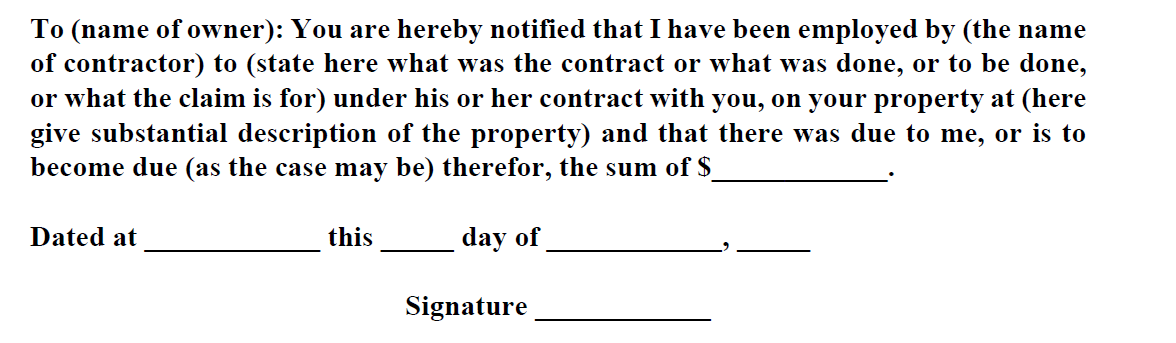
Statutory Form Notice Under 770 ILCS 60/24(a)
770 ILCS 60/24(a) provides the following form notice for subcontractors to use when preserving their Illinois mechanic lien rights:
Residential Projects: The Additional 60-Day Notice
60-Day Notice for Owner-Occupied Residences
In addition to serving the 90-day Section 24 notice, subcontractors working on an owner-occupied, single-family residence must serve a separate 60-day notice under 770 ILCS 60/5(b) and 60/21(c). This notice must be delivered to the owner — either personally or via certified mail — within 60 days from the first day the subcontractor furnished lienable material or services.
This is an additional obligation, not a substitute for the 90-day Section 24 notice. Failing to serve the 60-day residential notice can extinguish the subcontractor's lien rights on that project entirely, even if all other requirements are met.
Subcontractor Lien Amount Limitations
A subcontractor's lien is limited by the amount the property owner owes to the general contractor at the time the Section 24 notice is received. If the owner has already paid the GC in full before receiving the subcontractor's notice, the subcontractor's lien may be extinguished entirely — even if the GC failed to pay the sub. This is one of the strongest defenses available to property owners and underscores why serving the Section 24 notice early is critical.
The lien amount must also exclude non-lienable charges such as finance charges, late fees, and attorney fees incurred before filing. Overstating the lien amount can be grounds for invalidation or sanctions.
Recording and Enforcing a Subcontractor's Lien
To properly perfect a lien claim, the subcontractor must record the verified claim with the County Recorder of Deeds within four months of its completion date under 770 ILCS 60/7. This preserves priority against third parties such as creditors, lenders, and subsequent purchasers.
After recording, the subcontractor must file a foreclosure action within two years of their last date of work. 770 ILCS 60/9, 60/28. During the foreclosure, the court evaluates whether the subcontractor complied with every statutory requirement — timely Section 24 notice, proper lien form, recording within the 4-month window, and accurate property description. See our step-by-step filing guide for detailed procedural instructions.
Section 34 Demand Warning
A property owner may serve a Section 34 demand, compressing the 2-year enforcement window to just 30 days. If you fail to file suit within 30 days of receiving this demand, your lien is permanently forfeited.
Owner Defenses Against Subcontractor Liens
Property owners have several defenses available against a subcontractor's mechanic lien. The most common defense is that the subcontractor failed to serve a timely Section 24 notice. If no proper notice was served, the owner's liability is limited to the amount unpaid on the owner's contract with the general contractor at the time the lien claim is recorded — and if the owner has already paid in full, the subcontractor's lien may be extinguished entirely.
Owners may also challenge the lien on procedural grounds: an incorrect legal description, a lien amount that exceeds what is owed, or a lien recorded after the statutory deadline. Under 770 ILCS 60/38, an owner can petition the court to substitute a surety bond for the lien, which removes the encumbrance from the property while the dispute is litigated.
Evidence Checklist for Subcontractors
Start collecting these records on day one of every project to protect your lien rights:
Subcontractor Evidence Checklist
- Signed subcontract with the general contractor, including all amendments
- Change orders with written approval from the GC or owner
- Daily time sheets signed by the foreman or superintendent
- Material delivery tickets with dates, quantities, and signatures
- Pay applications submitted to the GC with dates
- Lien waivers exchanged — partial and final, conditional and unconditional
- Certified mail receipts for the 60-day owner notice (residential projects)
- Certified mail receipts and return receipt cards for the 90-day Section 24 notice
- Correspondence with the GC documenting payment demands and disputes
- Photographs with date stamps showing work in progress at the project site