April 29, 2026 · Mechanic Liens
Illinois 60-Day Residential Mechanic Lien Notice for Subcontractors
Subcontractors on existing owner-occupied single-family homes in Illinois face a notice obligation that does not exist on commercial or public projects. Sections 5 and 21 require a 60-day notice to the homeowner, with one narrow exception under Crawford Supply.
Subcontractors and material suppliers furnishing labor or materials on an existing owner-occupied, single-family home in Illinois face a notice obligation that does not exist on commercial projects, public works, or new construction. Sections 5 and 21 of the Illinois Mechanics Lien Act require the subcontractor to serve the owner with a 60-day notice describing its work and its right to claim a lien. 770 ILCS 60/5(b); 770 ILCS 60/21(c). The clock runs from the first day the subcontractor furnishes lienable labor or materials, not from the day the work ends. Miss it, and the lien claim is at risk. Serve it correctly, and the claim survives even if the contractor never pays.
This article walks through the rules that decide whether a subcontractor on an Illinois owner-occupied residential job keeps its lien rights or loses them. It explains the statutory basis, the form the notice must take, the way the 60-day and 90-day notices interact, the narrow window where late notice can still preserve a lien, and the cases that have shaped the doctrine. The discussion is limited to existing owner-occupied single-family residential property. Different rules apply on commercial work, public projects, and homes that are vacant or under new construction.
Statutory Basis: Sections 5 and 21 of the Mechanics Lien Act
The Illinois Mechanics Lien Act, 770 ILCS 60, gives subcontractors a lien on improved real estate to secure payment for labor and materials. On most jobs, the principal procedural hurdle for a subcontractor is the 90-day notice required by Section 24. 770 ILCS 60/24. On an existing owner-occupied, single-family home, two notices are required, not one.
Section 5 of the Act addresses contractor and subcontractor disclosure obligations to the owner. 770 ILCS 60/5. Section 21 addresses the subcontractor's lien right and the procedure to perfect it. 770 ILCS 60/21. Read together, they require the subcontractor to put the homeowner on written notice of its work, and of the homeowner's potential lien exposure, within 60 days of the first day the subcontractor furnishes labor or materials.
The purpose of the 60-day notice is straightforward. Homeowners on small residential jobs typically deal with one general contractor, write one set of checks, and never meet the trades and suppliers who actually do the work. Without notice, a homeowner has no way to know which subcontractors and suppliers are owed money, no way to demand lien waivers before payment, and no way to protect against paying for the same work twice. The notice forces disclosure and gives the homeowner a chance to intervene before the contractor disappears with the funds.
For background on the broader statutory framework, see our overview of Illinois mechanic lien rights and the subcontractor lien rights guide.
Who Must Serve, When, and How
The 60-day notice is a subcontractor obligation. A general contractor with a direct contract with the owner is governed by different sections of the Act and does not serve a 60-day notice on its own customer. A subcontractor, sub-subcontractor, or material supplier without a direct contract with the homeowner does serve the notice.
Service must occur within 60 days of the date the subcontractor first furnished labor or materials to the property. 770 ILCS 60/5(b)(ii). The clock does not wait for the work to be substantial, the invoice to issue, or the contractor to fall behind on payments. It starts on day one. A delivery, a layout, an inspection, a trench dug for utilities, any lienable performance is enough to start the count.
Two methods of service satisfy the statute. The subcontractor can serve the owner personally. The subcontractor can also serve the owner by certified mail, return receipt requested. If certified mail is used, the notice is deemed served at the time of mailing, not at the time of delivery. That detail matters when the 60-day window is closing and the owner is hard to reach.
What the Notice Must Say
Section 5(b) prescribes the form. The notice must identify the subcontractor by name and address. It must state the date the subcontractor began work or began delivering materials. It must describe the type of work performed and to be performed, or the type of materials, fixtures, apparatus, machinery, forms, or formwork delivered and to be delivered. It must name the contractor that requested the work. The text must appear in at least ten-point boldface type.
The statute also dictates the warning the notice must contain. The warning advises the homeowner that the subcontractor has performed work for, or delivered material to, the homeowner's contractor; that those services or materials are being used to improve the residence; and that the subcontractor can lien the residence if the contractor fails to pay. The warning also instructs the homeowner to request a lien waiver from the contractor when paying for the home improvements. Drafting the notice without the prescribed warning, or in smaller type than the statute specifies, hands the homeowner an unnecessary defense.
For the full statutory walkthrough on this page, see our Illinois 60-day residential notice page.
The 60-Day Notice Does Not Replace the 90-Day Notice
A common mistake is treating the 60-day notice as a substitute for the 90-day notice required by Section 24. It is not. Both notices are required on existing owner-occupied residential work, and each serves a different function.
The 60-day notice tells the homeowner that the subcontractor is on the job and may eventually claim a lien. The 90-day notice, served within 90 days after the subcontractor's last day of work, formally notifies the owner of the amount of the lien claim and is the predicate to recording a verified lien claim under Sections 7 and 21. 770 ILCS 60/7; 770 ILCS 60/21; 770 ILCS 60/24. Illinois courts have held that compliance with one does not excuse compliance with the other. Gary L. Brown Painting & Decorating, Ltd. v. David E. Comeau, Ltd., 159 Ill.App.3d 746, 512 N.E.2d 795 (2d Dist. 1987). A subcontractor that nails the 60-day notice and forgets the 90-day notice loses its lien. A subcontractor that nails the 90-day notice and forgets the 60-day notice may still keep its lien, but only under the prejudice rule discussed below.
For a deeper walk-through of the 90-day notice and the cases interpreting its strict-compliance requirements, see our Illinois Section 24 notice page and the mechanic lien deadlines overview.
The Crawford Supply Prejudice Rule
Most procedural deadlines under the Mechanics Lien Act demand strict compliance. The 60-day residential notice is the exception. The First District in Crawford Supply Co. v. Schwartz, 396 Ill.App.3d 111, 919 N.E.2d 5 (1st Dist. 2009), held that the failure to serve a 60-day notice will not invalidate the lien claim when the homeowner has not been prejudiced by the subcontractor's silence.
The facts in Crawford Supply are instructive. The subcontractor performed work on an owner-occupied single-family home, did not serve a 60-day notice, but did timely serve the 90-day notice. At the moment the 90-day notice arrived, the homeowner had not yet paid the general contractor for the subcontractor's work. The court reasoned that enforcing the lien would not require the homeowner to pay twice for the same labor or materials, and so the homeowner had suffered no prejudice from the missing 60-day notice. The lien stood.
The mechanism comes directly from Section 5(b)(iii) of the Act. 770 ILCS 60/5(b)(iii). When the subcontractor serves the 60-day notice late, the lien is preserved only to the extent the homeowner has not made payments to the contractor between the 60-day deadline and the day the late notice arrives. Payments the homeowner already made in reliance on the absence of notice are protected. Sums the homeowner still owes the contractor remain reachable.
This is the only place in the Mechanics Lien Act where a court can weigh prejudice as a basis for excusing a deadline. Every other procedural deadline in the Act is a hard wall. Subcontractors should not treat Crawford Supply as a safety net. It is a narrow doctrine that depends entirely on the homeowner not having paid out the funds the subcontractor wants to reach. By the time the contractor has cashed the homeowner's final draw, the doctrine is gone.
When the 60-Day Rule Does Not Apply
The 60-day notice is a residential rule. It applies only to existing owner-occupied single-family residences. If the property is a commercial building, an apartment complex, a public works project, a home under new construction that has never been occupied, a vacant home held as an investment, or a rental, the 60-day notice is not required. The subcontractor still must serve the 90-day Section 24 notice, but the 60-day clock does not run.
The Fifth District applied this principle in Pittman v. Manion, 212 Ill.App.3d 342, 570 N.E.2d 1169 (5th Dist. 1991), holding that the 60-day notice was not required where the owners were not residing on the property during construction. Subcontractors and suppliers should confirm occupancy at the start of the job. A property that is owner-occupied at the time of contract may sit vacant during a long renovation, and a property vacant at the start may be occupied before work ends. The status that matters is whether the property is owner-occupied during the period of construction.
The Section 5 Sworn Statement Is Not a Substitute
Section 5(b)(i) of the Act requires the contractor to provide the owner with a sworn statement listing each person and entity furnishing labor or materials on the property, along with the value of the work to be performed. 770 ILCS 60/5(b)(i). When the contractor's sworn statement discloses the subcontractor's name and the value of its work, the subcontractor's lien is preserved up to that disclosed value, even if the subcontractor never serves a separate 60-day notice. If the homeowner has not been prejudiced, however, the lien is not capped at the disclosed amount.
A contractor's sworn statement may also satisfy the 90-day Section 24 notice in the right circumstances, but it does not reliably satisfy the separate 60-day notice obligation. A subcontractor that relies on the contractor to disclose its name and amount accurately is depending on the same contractor that has not paid it. Serving the 60-day notice directly is cheaper than litigating whether the contractor's sworn statement was complete.
Timing the 90-Day Notice: When Does Work End?
Because both notices are required on owner-occupied residential work, the 90-day clock matters as much as the 60-day clock. Section 24(a) requires the subcontractor to serve the owner with a verified notice of claim for lien within 90 days after the completion of its work. 770 ILCS 60/24(a). The First District in Cordeck Sales, Inc. v. Construction Systems, Inc., 382 Ill.App.3d 334, 887 N.E.2d 474 (1st Dist. 2008), explained that completion under the Act refers to completion of the work for which the contractor seeks to enforce its lien, not completion of the contract as a whole. Merchants Environmental Industries, Inc. v. SLT Realty Limited Partnership, 314 Ill.App.3d 848, 731 N.E.2d 394 (1st Dist. 2000).
That distinction matters because subcontractors often return to a job after substantial completion to perform punch list items, warranty repairs, or trivial corrective work. Under Illinois law, work that is trivial and not essential to completion of the contract does not extend the 90-day window. Braun-Skiba, Ltd. v. LaSalle National Bank, 279 Ill.App.3d 912, 665 N.E.2d 485 (1st Dist. 1996); Miller Bros. Industrial Sheet Metal Corp. v. LaSalle National Bank, 119 Ill.App.2d 23, 255 N.E.2d 755 (2d Dist. 1969). Courts evaluate several factors. They look at whether the work was necessary to complete the contract. Capital Plumbing & Heating Supply Co. v. Snyder, 2 Ill.App.3d 660, 275 N.E.2d 663 (4th Dist. 1971); De Anguera v. Arreguin, 92 Ill.App.2d 381, 234 N.E.2d 808 (2d Dist. 1968). They look at whether the work was done at the request of the owner or whether the contractor returned on its own. Alexander Hendry Co. v. Mooar, 242 Ill.App. 516 (1st Dist. 1926). Maintenance and corrective work outside the original contract scope will not extend the deadline.
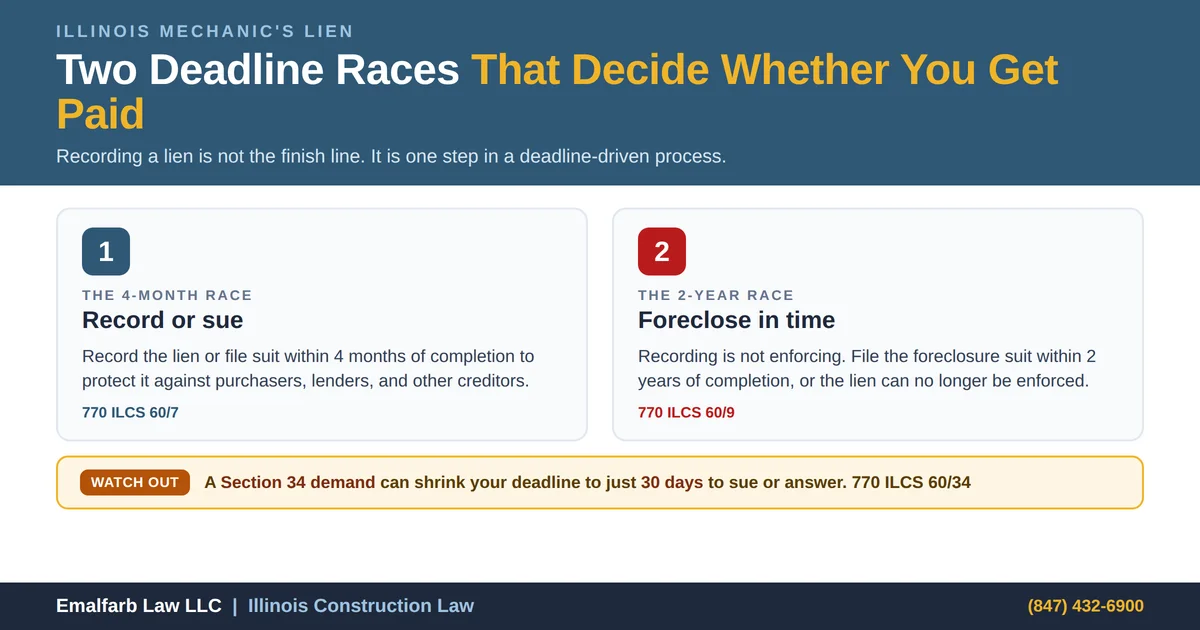
A subcontractor that miscalculates the completion date risks filing a lien claim outside the 90-day window. The safer practice is to identify a defensible last day of original-scope work and run the 90-day clock from that date, treating any later return visit as a separate question. For a deeper dive, see our four-month recording deadline and subcontractor deadlines pages.
Form Versus Substance: When a Section 24 Notice Names the Contractor Incorrectly
On owner-occupied residential work, the 90-day Section 24 notice carries the same drafting risks as it does on any other Illinois project. One that comes up often: the subcontractor identifies the contractor with a slightly wrong legal name, for example, the operating affiliate is named instead of the contracting entity, or a legal-suffix variation slips into the notice. The owner then argues the misnomer voids the notice and defeats the lien. Illinois case law generally does not support that argument when the notice otherwise functions as lien notice and the owner suffered no prejudice.
The reason starts with the statute itself. Section 24 provides a sample form notice that says, in part, "I have been employed by (the name of contractor)." The Illinois Appellate Court has read that form as permissive, not mandatory. In A.Y. McDonald Manufacturing Co. v. State Farm Mutual Automobile Insurance Co., 225 Ill.App.3d 851, 587 N.E.2d 623 (3d Dist. 1992), the trial court invalidated a Section 24 notice because it failed to name the subcontractor's contracting party. The appellate court reversed, holding that Section 24 requires the notice to be in writing, of the claimant's claim, stating the amount due, and timely delivered to the owner. The "name of contractor" language appears only in the suggested form, and omission of the contractor's name does not invalidate the notice.
The Second District extended the reasoning in Matteo Construction Co. v. Teckler BLVD Development Site, LLC, 2020 IL App (2d) 190766, 177 N.E.3d 747. Matteo held that Section 24 does not require use of the statutory form at all. A claim of lien served on the owner by certified mail satisfied Section 24 because it gave the owner the parties' names, the property description, the work performed, and the amount due. The claim contained the substance Section 24 requires, even though it did not track the statutory form.
Older Illinois authority points the same way in lien cases generally. In J.E. Milligan Steel Erectors, Inc. v. Garbe Iron Works, Inc., 139 Ill.App.3d 303, 486 N.E.2d 945 (2d Dist. 1985), the lien claim referred to the owner by variations of its corporate name. The court declined to defeat the lien because all of the names obviously referred to the same entity, the owner's agent had been served, the owner was not misled, and there was no prejudice. Milligan is owner-misnomer, not contractor-misnomer, but its principle applies by analogy: a lien should not fail because of a naming defect where the parties understood the intended entity, the notice was received, and no party was prejudiced.
Cordeck Sales, the same case discussed above on completion of work, supports the broader proposition that Illinois courts will overlook certain technical defects in Section 24 notice where the notice is actually received and the statutory purpose is satisfied. The doctrine builds on A.Y. McDonald and similar authority, and is consistent with how courts evaluate other lien-notice questions: the touchstone is whether the document, taken as a whole, gave the owner meaningful notice of the lien claim.
The defense case the owner usually cites is Seasons-4, Inc. v. Hertz Corp., 338 Ill.App.3d 565, 788 N.E.2d 179 (1st Dist. 2003). The court there rejected a faxed letter as a Section 24 notice because it was not served by an authorized method, did not say it was asserting a mechanic's lien, did not clearly identify the lien claim or the property, and looked more like a payment-suspension letter than a lien notice. Seasons-4 matters, but it is distinguishable from the typical contractor-misnomer scenario. Seasons-4 concerned a document that did not function as lien notice at all. It is not authority for the proposition that a Section 24 notice fails because the contractor's exact legal name is imperfect.
Two practical takeaways follow for subcontractors and suppliers serving Section 24 notice on owner-occupied residential work. First, a notice that says it is asserting a mechanic's lien, identifies the claimant, states the amount due, describes the work or materials, identifies the property, and is delivered by an authorized method gives the owner the substance Section 24 requires. A near-name misidentification of the contractor, particularly between affiliated entities or legal-suffix variations, is unlikely to defeat the notice on its own under A.Y. McDonald and Matteo. Second, the safer practice on every job is still to confirm the contractor's exact legal name before drafting the notice, and to serve a corrected notice promptly if a naming error is discovered inside the 90-day window. The defense bar will press the misnomer argument every time, and litigating it costs the subcontractor real money even when the lien ultimately holds. For the deeper case-law discussion and how this principle interacts with the rest of Section 24, see our Section 24 notice page.
Serving Owners Who Cannot Be Found
A homeowner is not always available to receive personal service or sign for certified mail. Section 25 of the Act provides an alternative. 770 ILCS 60/25. When the owner of record, the owner's agent, the architect, the superintendent, or the lending agency cannot be found in the county where the improvement is located, or does not reside in the county, the subcontractor may file a verified lien claim within 90 days after completion of its work as a substitute for personal or certified mail service.
The threshold question is what counts as a reasonable search. A subcontractor that checks only the abstract books at the recorder's office, but skips the grantor-grantee index, has not exercised reasonable diligence. Edward Electric Co. v. Automation, Inc., 164 Ill.App.3d 547, 518 N.E.2d 172 (1st Dist. 1987). A subcontractor whose employee makes two phone calls in a single day, while the homeowner is performing household duties and is regularly outside in the yard where service could have been made, has not exercised reasonable diligence either. Western Plumbing Supply Co. v. Horn, 269 Ill.App. 612 (1st Dist. 1933). The diligence requirement is real, and a subcontractor that defaults to the Section 25 alternative without documenting its search will face an evidentiary problem if the lien is contested.
Practical Guidance for Subcontractors and Suppliers
The following steps protect lien rights on owner-occupied single-family residential work in Illinois.
Confirm at the start of the job that the homeowner is currently residing on the property, and document that confirmation. The 60-day clock turns on this fact. If the property is unoccupied or new construction, the 60-day notice is not required, but the 90-day Section 24 notice still is.
Calendar the 60-day deadline on the day the subcontractor first furnishes labor or materials, not on the day the contract is signed. A delivery to the site is enough to start the clock.
Draft the 60-day notice using the statutory form and warning language, in at least ten-point boldface type. Identify the subcontractor, the start date, the scope of work or materials, and the contractor that requested the work.
Serve the notice by certified mail, return receipt requested, or by personal service, and keep the proof. Certified mail service is deemed complete on mailing, which gives the subcontractor cover when the deadline is tight.
Calendar the 90-day Section 24 notice from the last day of original-scope work, treating later punch list items as a separate question. Serve the 90-day notice on the homeowner, the contractor, and any known lender.
If the 60-day deadline is missed, do not abandon the lien. Serve the 60-day notice immediately. Under the Crawford Supply rule, the lien is preserved to the extent the homeowner has not yet paid the contractor for the subcontractor's work.
When the homeowner cannot be found in the county and a reasonable search confirms it, document each step of the search before relying on the Section 25 filing alternative.
For industry-specific notice walkthroughs, see our pages for subcontractors, material suppliers, electricians, plumbers, and HVAC contractors.
Get Help Before the Clock Runs
The 60-day notice is the only deadline in the Illinois Mechanics Lien Act where a court has discretion to forgive a missed step, and that discretion runs only as far as the homeowner's prejudice will allow. Every other deadline in the Act is unforgiving. Subcontractors and material suppliers working on Illinois owner-occupied residential property should treat the 60-day clock the way they treat the 90-day clock: as a date that must be met, not a date that can be argued around after the fact.
If you are a subcontractor, supplier, or contractor with a payment problem on an Illinois owner-occupied single-family home, contact Emalfarb Law for a deadline check. We will confirm which notices are still available, what the 60-day and 90-day clocks look like for your job, and the strongest available remedy.