May 1, 2026 · Mechanic Liens
Illinois Mechanic Lien Last Day of Furnishing: When the 4-Month Clock Starts
Every Illinois mechanic lien deadline runs from the claimant's last day of furnishing. The Illinois Supreme Court in Weather-Tite drew the line: punch-list and warranty work do not reset the 4-month clock under 770 ILCS 60.
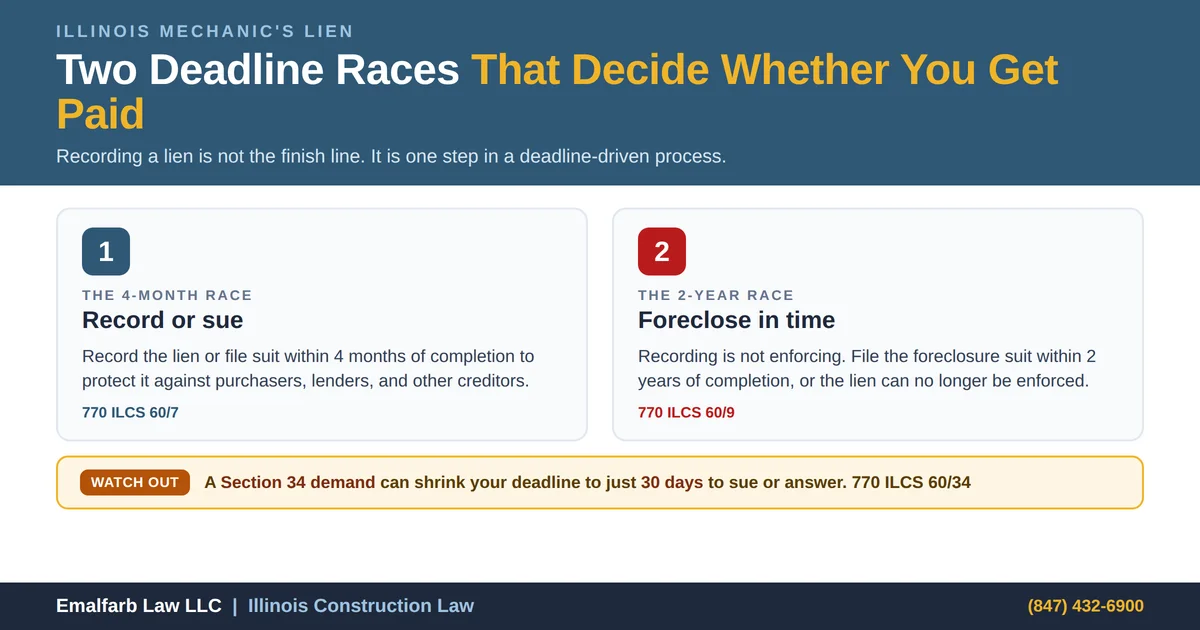
Every deadline under the Illinois Mechanics Lien Act runs from a single date: the claimant's last day of furnishing labor or materials. 770 ILCS 60/7. The 60-day residential notice, the 90-day Section 24 notice, the 4-month recording window, and the 2-year enforcement period all measure backward from that day. Get the date right and every other deadline falls into place. Get it wrong and a technically-timely-looking lien collapses on summary judgment.
This article explains how Illinois courts identify the last day of furnishing, why punch-list and warranty work do not extend the clock, what documentation actually proves the date in court, and the cases that have shaped the doctrine. It is the foundation for every other deadline under the Illinois mechanic lien deadlines framework and the single most-litigated question in Illinois mechanic lien practice.
The Statutory Anchor: 770 ILCS 60/7
Section 7 of the Illinois Mechanics Lien Act requires a verified lien claim to be recorded with the County Recorder of Deeds within four calendar months "after completion" of the claimant's work. 770 ILCS 60/7. The Illinois Supreme Court has long read "completion" as synonymous with the last day the claimant furnished lienable labor or materials to the improvement, not the date of substantial completion of the project as a whole.
The distinction matters because most construction projects close out over weeks or months. The general contractor reaches substantial completion. The architect issues a punch list. Trades return for callbacks. Owners move in. Final invoices issue. None of those events controls the §7 clock for a particular subcontractor or supplier. The only date that matters is the last day that particular claimant actually performed work or delivered materials that improved the property.
Weather-Tite and the Punch-List Rule
The leading authority is Weather-Tite, Inc. v. University of St. Francis, 233 Ill. 2d 385 (2009). A roofing contractor completed its installation, then returned months later to perform punch-list items identified by the architect. The contractor recorded its lien within four months of the punch-list visit, but more than four months after the original installation was complete. The Illinois Supreme Court held the lien was untimely.
The Court drew a sharp line. The test for whether later work extends the §7 clock is not whether the claimant was physically present on the site, not whether the claimant submitted a final invoice, and not whether the contract was technically still open. The test is whether the later work added new value to the improvement. Punch-list items, by their nature, correct or complete work the claimant was already obligated to perform under the original contract. They do not add new value. They do not extend the clock.
Weather-Tite is the deadline practitioner's lodestar. Every contemporary Illinois deadline dispute begins with the question: did the later work add new value, or did it merely complete what the contract already required? If the answer is the latter, the §7 clock ran from the earlier date.
Warranty Work and Callback Visits
Warranty repairs sit in the same bucket as punch-list items. A subcontractor that returns six months after substantial completion to fix a leaky window or recalibrate an HVAC system is performing under the warranty obligation in the original contract. The visit does not constitute new furnishing. Illinois courts uniformly hold that warranty callbacks do not extend the §7 deadline.
The same rule applies to inspection visits, equipment retrieval, and post-completion site walks. None of those activities furnishes labor or materials that improve the property. They are administrative wrap-up of the work already performed.
Practitioners occasionally argue that warranty work "counts" because the contract obligated the claimant to perform it. The argument confuses contractual obligation with statutory definition. The Mechanics Lien Act is a creature of statute, and the §7 clock measures statutory furnishing, not contractual scope. First Federal Savings & Loan Ass'n v. Connelly, 97 Ill. 2d 242 (1983), forecloses the equitable workarounds.
Change Orders and Additional Scope
Change orders are different. Work performed under a written change order, work that adds new scope, new materials, or new labor that was not within the original contract, does add new value to the improvement. That work generally extends the last-furnishing date to the date the change-order work was completed.
The keyword is "new." A change order that simply describes corrective work to remediate a defect in the original installation does not reset the clock; it merely papers over warranty or punch-list scope. A change order for additional rooms, additional finishes, an upgraded mechanical system, or new structural elements does. Illinois courts examine the substance of the change-order work, not the label.
Two practical points follow. First, the change order should be in writing, signed by an authorized agent of the owner or the contractor that hired the claimant, and tied to a defined scope. Oral change orders rarely survive a deadline challenge. Second, the change-order work should be tracked separately in daily logs and pay applications. A claimant that lumps change-order labor into general project hours hands the defense an easy argument that no separate "furnishing" occurred.
The Trivial-Work Doctrine
Illinois courts have also recognized a trivial-work doctrine. A claimant cannot manufacture a later last-furnishing date by returning to the site to perform de minimis tasks for the purpose of restarting the clock. Sweeping a job site, retrieving tools, signing off on inspections, or attending a final walk-through are not lienable furnishing. The work must be substantive and of real value to the improvement.
Need Help Establishing Your Last Day of Furnishing?
Send us your daily logs, delivery tickets, and pay applications. We will assess whether your last day of work supports a timely lien, and what documentation gaps could be challenged in court. No charge for the review.
All inquiries answered within 1 business day.
Cordeck Sales, Inc. v. Construction Systems, Inc., 382 Ill. App. 3d 334 (1st Dist. 2008), addressed the related question of when a project is "completed" for §7 purposes and reinforced that the analysis is substantive, not formal. Recording a lien based on a trivial visit is a recipe for a Section 34 demand and a quick dismissal.
How to Document the Last Day of Furnishing
The burden of proving the last day of furnishing rests on the lien claimant. The court will not credit conclusory affidavits or after-the-fact reconstructions when contemporaneous records exist (or should have existed). Practitioners who litigate these disputes year after year see the same documentation gaps, and the same defense playbook, every time.
The documentation that survives a deadline challenge is contemporaneous, dated, and specific. Daily job logs identifying the date, the workers on site, and the nature of the work. Delivery tickets with site signatures and dates. Signed time sheets matching workers to project hours. Pay applications with line-item descriptions tying labor and materials to specific scope. Change orders in writing. Date-stamped photographs of the work in progress. Email correspondence with the owner, contractor, or architect referencing specific dates of work.
What does not survive a challenge: invoices generated weeks after the work was performed, summary affidavits without supporting records, and "reconstructed" daily logs prepared in anticipation of litigation. Defense counsel will subpoena the underlying records, and the gap between the contemporaneous documentation and the affidavit becomes the heart of cross-examination.
For a complete deadline-evidence checklist tailored to Illinois mechanic lien practice, see our Illinois mechanic lien deadlines hub and the 4-month recording deadline guide.
Why the Last Day Controls Every Other Deadline
The last day of furnishing is not a freestanding question. It is the trigger for every other Mechanics Lien Act deadline. A miscalculation cascades through the whole filing.
If the last day is wrong, the 90-day Section 24 notice is either premature or late. 770 ILCS 60/24. A premature notice is generally curable. A late notice is fatal to the subcontractor's lien against the owner, the lender, and third parties. If the last day is wrong, the 4-month recording window is either too generous or already closed. 770 ILCS 60/7. A lien recorded after the statutory window loses its priority over intervening third-party interests and becomes practically unenforceable. If the last day is wrong, the 2-year foreclosure deadline shifts. 770 ILCS 60/9. The statute of limitations does not pause for a misidentified date.
On owner-occupied single-family residential work, an additional cascade applies. The 60-day residential notice runs from the first day of furnishing, but its viability depends on the same documentation that establishes the last day. See our Illinois 60-day residential notice guide.
Common Defense Tactics on the Last-Day Question
Defense counsel know the playbook. The first attack is documentary: subpoena the daily logs, time sheets, and delivery tickets, and look for the gap between the alleged last day and the last contemporaneous record. The second attack is substantive: argue that the alleged last-day work was punch-list, warranty, or trivial under Weather-Tite. The third attack is cross-examination: depose the project manager, the foreman, and the workers about what actually happened on the alleged last day.
Counter-strategies start at the project intake. A claimant that maintains daily logs from day one, signs delivery tickets at the site, and tracks change-order work separately has the records to defeat each line of attack. A claimant that did not, and there are many, needs to be candid with counsel about the documentation gaps before recording the lien. A weak last-day record is better addressed before a Section 34 demand forces the issue than after.
When to Consult Counsel
Three triggers should prompt an immediate call to a mechanic lien attorney. First, the project is closing out and the contractor has not paid. Second, the owner or general contractor has asked for a final lien waiver and the claimant is unsure of the last day of furnishing. Third, a Section 34 demand has arrived and the claimant has 30 days to file suit on a lien that may already be vulnerable on the last-day question.
Each of those triggers compresses the window for the documentation work that determines whether the lien is enforceable. The cost of an early consultation is small. The cost of recording a lien on a contestable last-day record is the lien itself, the attorney fees, and frequently a counterclaim under 770 ILCS 60/35 for damages caused by an invalid claim.
Bottom Line
Every Illinois mechanic lien deadline runs from the claimant's last day of furnishing labor or materials, and the Illinois Supreme Court drew a sharp line in Weather-Tite: only work that adds new value to the improvement extends the clock. Punch-list, warranty, and trivial visits do not. Change-order work does, when it represents new scope rather than corrective effort. Contemporaneous documentation, daily logs, delivery tickets, time sheets, change orders, photographs, is the foundation. A deadline dispute is won or lost in the records that exist on the day the work is performed, not in the affidavits filed after the contractor stops paying.
For a step-by-step walk-through of every deadline that runs from the last day of furnishing, including a free deadline calculator, see our Illinois mechanic lien deadlines hub.