June 26, 2026 · Mechanic Liens
Illinois Mechanic's Lien: The Two Deadline Races to Get Paid
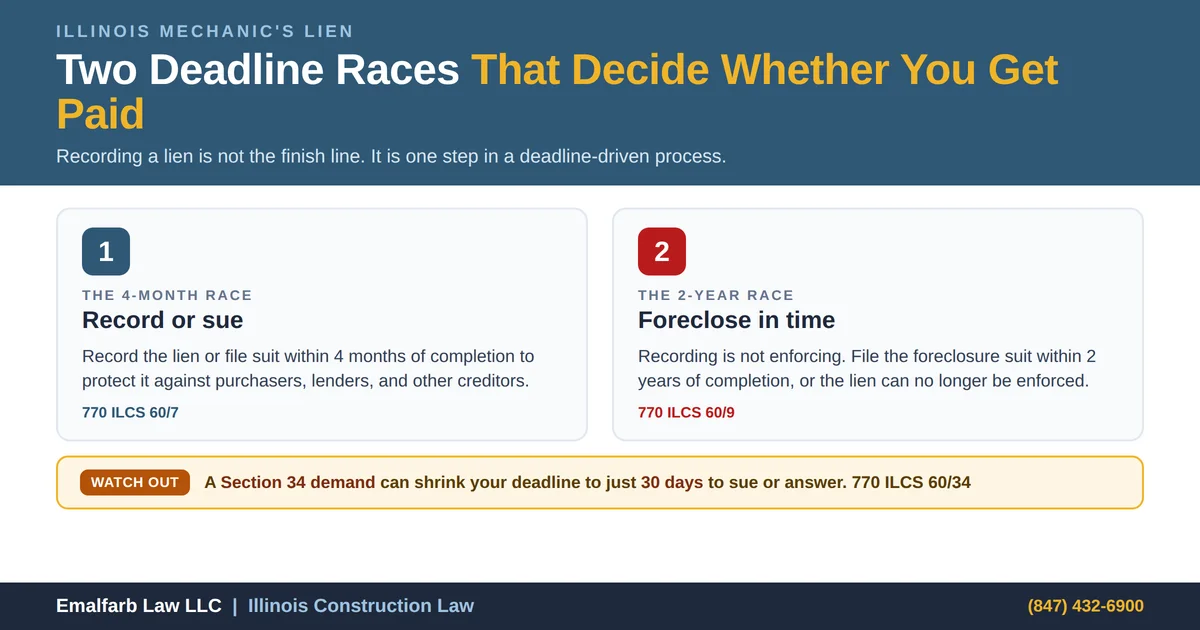
Illinois mechanic's lien rights are deadline-driven. Recording within four months protects the lien against third parties, but enforcing it is a separate race: the foreclosure suit must be filed within two years, and a Section 34 demand can shrink that window to 30 days.
Illinois mechanic's lien law gives contractors, subcontractors, and suppliers a powerful tool to secure payment for labor, services, and materials furnished to improve real property. But the lien right is deadline-driven. A claimant who misses the wrong deadline can lose priority, lose leverage, or lose the lien entirely.
Two deadlines deserve particular attention:
- The four-month recording or suit deadline, which is especially important when third-party interests are involved; and
- The two-year foreclosure deadline, which governs when a lien-enforcement lawsuit must be filed.
A third, less predictable deadline can also appear: a 30-day demand-to-sue deadline under Section 34 of the Illinois Mechanics Lien Act.
This article explains how these deadlines work, why they are often confused, and why recording a lien is not always the final step.
One caveat before the dates. What follows is a timing overview built around Sections 7 and 9, which speak to the contractor's lien. A subcontractor carries separate statutory notice obligations, including notice to the owner under 770 ILCS 60/24, and nothing below replaces that analysis.
The Four-Month Deadline: Protecting the Lien Against Third Parties
Section 7 of the Illinois Mechanics Lien Act provides that a contractor cannot enforce a mechanic's lien "against or to the prejudice of" another creditor, encumbrancer, or purchaser unless, within four months after completion, the claimant either:
- files suit to enforce the lien; or
- records a verified claim for lien in the county where the improved property is located.
See 770 ILCS 60/7.
In practical terms, the four-month deadline is the deadline most people associate with "recording the lien." Recording within four months is critical when the claimant wants the lien to be effective against later purchasers, lenders, mortgagees, or other third parties with interests in the property.
A timely recorded lien should include the statutory information required by Section 7, including a brief statement of the claimant's contract, the balance due after credits, and a sufficiently correct property description. When third-party rights are at stake, Illinois courts tend to scrutinize compliance more strictly because the recorded lien is meant to give notice to people who may search the property records.
Important Nuance: Four Months Is Not Always the Same as Losing the Owner Claim
The four-month rule is sometimes described as if missing it automatically destroys the entire lien. That can be too broad.
Illinois law draws an important distinction between enforcing a lien against:
- the owner of the property; and
- third parties, such as creditors, encumbrancers, purchasers, or mortgagees.
A claimant who fails to record within four months may lose the ability to enforce the lien against, or to the prejudice of, those third-party interests. The claimant may still be able to enforce the lien against the original owner if the enforcement lawsuit is filed within the applicable two-year period. That is an owner-only route, and it is not a substitute for recording on time. It does nothing for a claimant facing a lender, a recorded mortgagee, a later purchaser, or any other qualifying third-party interest, which is what makes the four-month deadline operationally essential on nearly every file.
Illinois courts have recognized this distinction. In Bulletproof Plumbing Corp. v. Olhson, 2025 IL App (1st) 232007-U, the court held that where the lien foreclosure claim proceeded only against the owners, and no third-party interest remained, the claimant's failure to include the last date of work in the recorded lien did not defeat the owner-only foreclosure claim. The court emphasized that, as against the owners, the claimant needed to file suit within the two-year limitations period. Bulletproof is a useful recent illustration, but it is an order entered under Illinois Supreme Court Rule 23 and is not precedent except in the limited circumstances Rule 23(e)(1) allows.
Similarly, in Petroline Co. v. Advanced Environmental Contractors, Inc., 711 N.E.2d 1146, the court held that a subcontractor's failure to give notice to a mortgagee affected enforceability against the mortgagee, but did not necessarily invalidate the lien against the owners.
The practical lesson is simple: do not miss the four-month deadline. But if it has already passed, the analysis should not stop there. The claimant, owner, lender, and counsel should evaluate who the lien is being enforced against and whether the two-year enforcement period remains open.
The Two-Year Deadline: Recording Is Not the Same as Foreclosing
Recording a mechanic's lien is not the same thing as enforcing it.
Section 9 of the Illinois Mechanics Lien Act requires that a suit to enforce the lien, or a counterclaim asserting the lien, be filed within two years after completion of the contract, or within two years after completion of extra or additional work or furnishing of extra or additional materials, when applicable.
See 770 ILCS 60/9.
This means a claimant who timely records a lien still must calendar the foreclosure deadline. If payment is not resolved, the claimant must file the lien-enforcement lawsuit before the two-year period expires. Once the two-year period expires, the lien can no longer be enforced through foreclosure.
This is the second "race" in Illinois lien practice. The first race is often to record the lien within four months to protect against third parties. The second race is to file suit within two years to keep the lien enforceable.
Facing a Lien Deadline or a Section 34 Demand?
Illinois lien deadlines overlap, and a single demand can compress them to 30 days. If you are a contractor, subcontractor, owner, or lender trying to protect or challenge a lien, send us the contract, the last date of work, and any demand you have received, and we will map every deadline that applies before one of them passes. No charge for the initial assessment.
All inquiries answered within 1 business day.
The Section 34 Demand: The Deadline Can Suddenly Shrink to 30 Days
The two-year foreclosure period is not always the only enforcement deadline. Section 34 of the Illinois Mechanics Lien Act lets an owner, a lienor, a recorder acting under Section 3-5010.8 of the Counties Code, or any other person interested in the real estate, or that party's agent or attorney, serve a written demand requiring the lien claimant to commence suit to enforce the lien, or to file an answer if suit is already pending, within 30 days.
See 770 ILCS 60/34.
The formalities are not optional, and they cut both ways. The demand must be in writing, must be served on the claimant or its agent or attorney by personal service or by registered or certified mail with return receipt requested, and must carry the statutory forfeiture warning in at least 10-point bold type. A demand that misses a requirement can fail to start the clock at all. A demand that meets them starts a 30-day period that ends in forfeiture of the lien if the claimant does nothing.
That is why any written demand relating to a mechanic's lien should be reviewed the day it arrives. A claimant who thought it had months or even years left under the two-year rule may have 30. Owners, title insurers, lenders, and lien claimants should all treat a Section 34 demand as a litigation-triggering document, not ordinary correspondence.
Common Mistake: Using Minor Follow-Up Work to Extend the Deadline
Lien deadlines usually run from completion of the lienable work, not from every later contact with the project. Do not assume later activity restarts the clock.
The controlling question is not what the later activity is called. It is whether the work was substantial and essential to completion of the contract. Work that is trivial, insubstantial, collection-related, maintenance-related, or not required to complete the contract ordinarily will not extend the recording or enforcement period. Qualifying extra or additional work, labor, services, or materials furnished under the contract can bear on the timing analysis. So a claimant should not assume a punch-list visit or a warranty call revives anything, and should not assume the opposite either.
In Braun-Skiba, Ltd. v. LaSalle Nat. Bank, 665 N.E.2d 485, the court held that later work that was trivial and not essential to completion did not extend the four-month period for filing a lien. The court treated the lien as untimely and unenforceable against the third-party purchaser.
Whether later work qualifies is fact-specific. Calculate deadlines from the last date of substantial lienable work, and make sure the contemporaneous records identify the contractual basis for any later work, its scope, the date it was performed, and its value.
Practical Calendar Guide
Although every project should be reviewed on its own facts, Illinois lien claimants should generally calendar at least the following dates:
- 90 days, subcontractor notice deadline in many cases: Subcontractors may need to serve statutory notice to protect lien rights.
- 4 months, record lien or file suit to protect against third parties: Controls whether the lien can be enforced against, or to the prejudice of, creditors, encumbrancers, purchasers, and mortgagees. Priority is a related but separate analysis.
- 2 years, file suit or counterclaim to enforce the lien: Recording alone is not enough; the lien must be enforced before this deadline expires.
- 30 days after a Section 34 demand, accelerated deadline to sue or answer: A valid demand can shorten the enforcement timeline dramatically.
Because these deadlines can overlap, the safest approach is to calculate all of them as soon as nonpayment becomes a possibility.
Bottom Line
Illinois mechanic's lien law is not just about whether labor or materials were provided. It is also about whether the claimant acted on time.
The four-month deadline matters because it protects lien rights against third parties. The two-year deadline matters because it governs the lawsuit needed to enforce the lien. A Section 34 demand can compress the enforcement deadline to 30 days.
The key takeaway is this: recording a lien is not the finish line. It is one step in a deadline-driven process. Claimants should calendar the lien, notice, foreclosure, and demand-response deadlines immediately, and property owners or lenders should understand which missed deadlines affect them and which defenses belong only to third parties. If you are working through any of these Illinois lien deadlines, contact Emalfarb Law LLC.
Frequently Asked Questions
What are the two main deadlines for an Illinois mechanic's lien?
There are two deadlines every Illinois lien claimant should calendar. The first is the four-month deadline in 770 ILCS 60/7. Within four months after completion, the claimant must either record a verified claim for lien or file suit, and meeting this deadline is what protects the lien against later purchasers, lenders, and other creditors. The second is the two-year deadline in 770 ILCS 60/9, which requires the suit or counterclaim to enforce the lien to be filed within two years after completion. Recording within four months and foreclosing within two years are separate steps, not the same act. A claimant who records on time but never files the foreclosure suit within two years loses the ability to enforce the lien, so both dates belong on the calendar from the moment nonpayment looks possible.
Does missing the four-month deadline destroy the entire lien?
Not always. The four-month rule in 770 ILCS 60/7 governs enforceability against, or to the prejudice of, third parties such as creditors, encumbrancers, purchasers, and mortgagees, and missing it can defeat the lien as to those interests. Illinois law distinguishes that from enforcing the lien against the original owner. In Bulletproof Plumbing Corp. v. Olhson, 2025 IL App (1st) 232007-U, a nonprecedential order under Illinois Supreme Court Rule 23, the court held that where the foreclosure proceeded only against the owners and no third-party interest remained, a defect in the recorded lien did not defeat the owner-only claim, so long as suit was filed within the two-year period. Petroline Co. v. Advanced Environmental Contractors, Inc., 711 N.E.2d 1146, is similar as to a mortgagee. Treat the owner-only route as a fallback, not a substitute for recording on time.
Is recording a mechanic's lien the same as enforcing it?
No. Recording and enforcing are two different steps, and confusing them is a common and costly mistake. Recording a verified claim for lien within four months under 770 ILCS 60/7 gives notice and protects priority against third parties. Enforcing the lien is a separate act governed by 770 ILCS 60/9, which requires a suit to foreclose the lien, or a counterclaim asserting it, to be filed within two years after completion of the work. A claimant who records a lien and then waits, assuming the recording alone secures payment, can watch the two-year period expire and lose the right to foreclose. Once that period passes, the lien can no longer be enforced through foreclosure. The practical rule is to treat recording as one step in a deadline-driven process and to calendar the foreclosure deadline the same day the lien is recorded.
What is a Section 34 demand, and how fast must a claimant act?
A Section 34 demand can compress the enforcement timeline from years to 30 days. Under 770 ILCS 60/34, an owner, a lienor, a qualifying recorder, or another person interested in the real estate may serve a written demand requiring the claimant to commence suit to enforce the lien, or to file an answer if suit is already pending, within 30 days. The demand must be served on the claimant or its agent or attorney by personal service or by registered or certified mail with return receipt requested, and it must contain the statutory forfeiture warning in at least 10-point bold type. If a valid demand is served and the claimant does not act, the lien is forfeited. A claimant who believed it had years left can have 30 days. Any written demand touching a mechanic's lien should be reviewed the day it arrives and treated as a litigation-triggering document, not ordinary correspondence.
Can minor punch-list or warranty work extend an Illinois lien deadline?
Usually not, but the label is not what decides it. Illinois lien deadlines run from completion, and the controlling question is whether the later work was substantial and essential to completing the contract, not whether someone called it punch-list or warranty work. Work that is trivial, insubstantial, collection-related, maintenance-related, or not required to complete the contract ordinarily will not extend the recording or enforcement period. In Braun-Skiba, Ltd. v. LaSalle Nat. Bank, 665 N.E.2d 485, the court held that later work that was trivial and not essential to completion did not extend the four-month period, and treated the lien as untimely against a third-party purchaser. Qualifying extra or additional work furnished under the contract can bear on the analysis, but it is fact-specific. Calculate from the last date of substantial lienable work, and document the contractual basis, scope, date, and value of anything later.