September 16, 2026 · Firm News
Chicago Receivership Sale Paused: Buyer's Rights
The Real Deal reported that Judge Marian Perkins halted the short sale of the 57-unit Crestwood Apartments in Chicago, a building owned by a company of convicted investor Barry Drillman and in Fannie Mae foreclosure, and quoted Thomas Emalfarb, counsel for the buyer, on the buyer's request to reform the contract price after the Chicago Housing Authority suspended subsidies on 31 units. Here is the law behind the story: why a receiver's contract is never final until the court approves it, why a short sale adds the lender as a second gatekeeper, what Illinois requires to reform a price, and why Chicago Housing Authority contracts can move a building's value.
On September 15, 2026, The Real Deal reported that a Cook County judge halted the receivership sale of the Crestwood Apartments, a 57-unit building housing low-income seniors at 525 North Austin Boulevard on Chicago's Far West Side. The building is owned by a company of Barry Drillman, an investor who pleaded guilty in federal court to a mortgage fraud conspiracy, and it is the subject of a Fannie Mae foreclosure. Thomas Emalfarb of Emalfarb Law LLC represents the buyer in that matter and was quoted in the report. You can read The Real Deal's coverage here.
Because the matter remains pending, this article does not go beyond what The Real Deal published. It does not disclose client communications, litigation strategy, or facts outside the public record, and it does not predict how the court will rule. What it does is explain the Illinois and federal law that governs the questions the report raises, because those questions recur in every court-controlled sale of a Chicago apartment building: who must approve the deal, what happens when the property's assumed income turns out to be missing, and what a buyer can do about the price.
What The Real Deal Reported
According to the report, written by Sam Lounsberry, Judge Marian Perkins canceled a September 21 closing for the short sale of the Crestwood Apartments in order to hear emergency motions from the prospective buyer and from the building's tenants. The court also granted a motion by the Jane Addams Senior Caucus to intervene on behalf of the tenants. The report states that the caucus presented public records it says connect one of the buyer's managers to Drillman, the property's former operator, and that the tenants seek to vacate the sale on the strength of Drillman's prior mismanagement of the building. That is the intervenors' assertion as the report describes it, and this article takes no position on it.
The report identifies the prospective buyer as Crestwood CHI LLC, managed by Brooklyn-based investors Boruch Zucker and Elye Neustein. According to the report, the entity won a June auction with a $2.7 million bid that was intended to resolve a foreclosure complaint Fannie Mae filed in 2024 against Drillman's company after an alleged default on a $5.1 million mortgage loan originated by Berkadia in 2020.
The report states that Crestwood CHI sued earlier this month to lower the price, alleging that the court-appointed receiver, Frontline Real Estate Partners, concealed that the Chicago Housing Authority had suspended rent subsidies on 31 units because of failed inspections stemming from unfit property conditions. According to court records the buyer submitted, as described in the report, the housing authority also cited electrical deficiencies and an inoperable elevator with an estimated replacement cost of $300,000 to $400,000, declared the property uninhabitable, and issued emergency relocation vouchers to tenants.
Frontline's principal, Matt Tarshis, and its attorney, Mike Hopkins, are quoted as dismissing the buyer's claims. Their position, as reported, is that the buyer agreed to purchase the property as is, where is, and should have been aware of the extensive repairs required, including plumbing failures that require opening walls inside units. Mr. Tarshis is quoted as saying the buyer cannot prove any fraud and is attempting to delay the sale to obtain a better price. He also stated, according to the report, that the buyer was required to post 10 percent of the purchase price after its winning bid and could lose that deposit if the court upholds the purchase agreement and the buyer fails to close.
The report quotes Mr. Emalfarb for the buyer's position: the buyer wants to reform the contract at a more reasonable price, given the lack of Chicago Housing Authority subsidies it had originally anticipated as a revenue source. According to the report, both Fannie Mae and the receiver plan to formally object to any price reduction.
Fannie Mae's counsel, Nathan Grzegorek, is quoted as stating that the lender has been working to correct the conditions that placed the property in the City of Chicago's housing court for alleged building code violations, and that Fannie Mae has advanced $1 million to the receivership for repairs since the foreclosure began. A housing law attorney for the city, Steven McKenzie, is quoted as expressing concern about the prospective buyer's seriousness about completing repairs. Fannie Mae and Frontline, according to the report, argued that the tenants lack standing to disrupt the sale.
The report states that the court will hold a hearing on October 20 to determine whether the sale proceeds, the contract is reformed, or the property returns to the market, and that if the receivership sale is called off, Fannie Mae could still take title through a conventional foreclosure sale.
Drillman's background is a matter of public record. The United States Department of Justice announced in December 2023 that Boruch Drillman, also known as Barry Drillman, pleaded guilty to conspiracy to commit wire fraud affecting a financial institution in connection with a scheme involving more than $165 million in fraudulently obtained loans on multifamily and commercial properties. He was later sentenced to five years of probation. The Real Deal has covered the foreclosure and receivership proceedings that followed against his Chicago holdings since 2024.
None of that history decides the present question, which is a question about contract terms and court approval. The identity of the borrower explains why Fannie Mae is foreclosing and why a receiver holds the building. It does not change the law that governs the buyer.
A Receiver's Contract Is Always Subject to the Court
A receiver is an officer of the court, not a seller in the ordinary sense. The receiver holds the property for the benefit of everyone with an interest in it, and the receiver's authority extends exactly as far as the appointing order says and no farther.
In an Illinois mortgage foreclosure, a receiver is appointed under Section 15-1701 of the Illinois Mortgage Foreclosure Law and exercises the powers listed in Section 15-1704: to take possession, to manage and secure the property, to make leases, to collect rents, and to apply them as the court directs. See 735 ILCS 5/15-1701, 5/15-1704. A sale of the real estate is not among the default powers. It happens only when the court specifically authorizes it, and courts that do so ordinarily reserve the final decision on price and terms to themselves. A general equity receiver appointed under 735 ILCS 5/2-415 stands in the same position.
Federal receiverships are more prescriptive. When a receiver appointed by a federal court sells real estate privately, 28 U.S.C. § 2001(b) requires the court to appoint three disinterested appraisers, forbids a sale for less than two-thirds of the appraised value, requires publication of the proposed terms, and directs the court to confirm the sale only after a hearing, and not at all if a bona fide offer at least ten percent higher is received before confirmation. See also 28 U.S.C. § 2002 on notice.
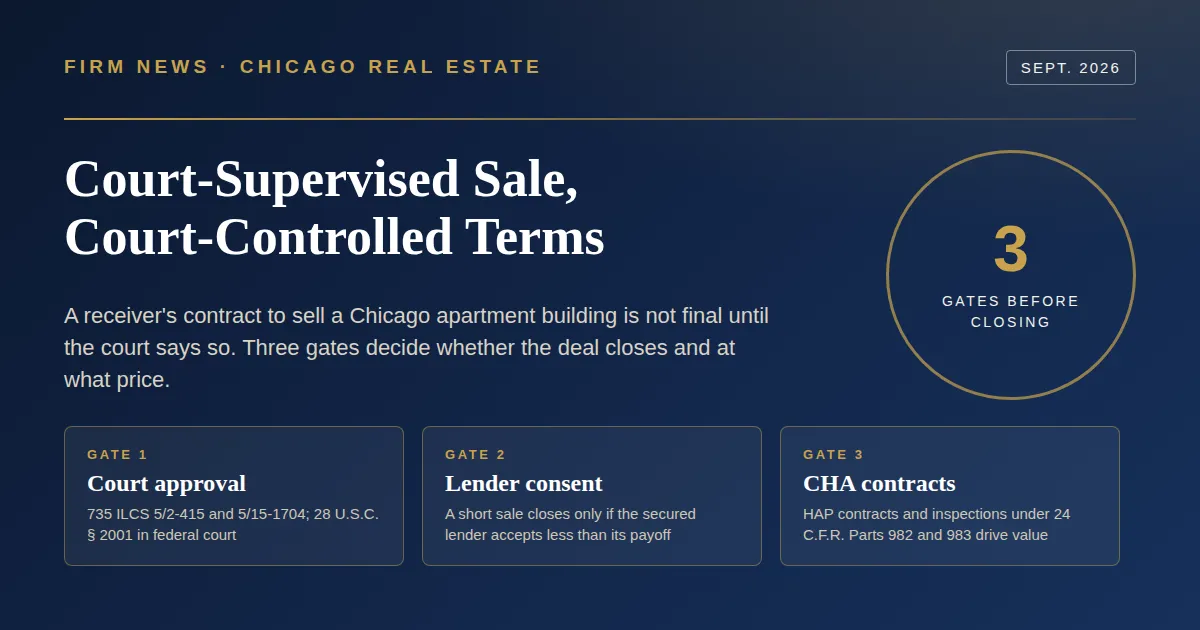
The point for a buyer is the same in either forum. The contract a buyer signs with a receiver is, in substance, a proposal that the receiver will present to the court. The order approving the sale, not the signature page, is what makes the deal enforceable. Until that order is entered, the court can decline to approve, can approve subject to conditions, can require the property to be exposed to higher bids, or can pause the process to resolve a dispute about the terms. A judge halting a receivership sale is therefore not an extraordinary event. It is the supervisory power working as designed.
Contracts drafted by receivers reflect this. They almost always contain an express court-approval condition, a broad as-is clause, a disclaimer of any warranty of income or condition, and a limitation of the buyer's remedies to return of the earnest money. A buyer should read those provisions before signing and should understand that they cut both ways. They protect the receiver from liability, and they also confirm that the price is not final until the court says it is.
Why a Short Sale Adds a Second Gatekeeper
The report describes the canceled September 21 closing as a short sale, and the reported figures explain why: a $2.7 million bid against a loan originally written for $5.1 million. In a short sale, the secured lender agrees to accept less than the balance it is owed and to release its mortgage so that the buyer can take title free of it. That consent is a separate condition from court approval, and the two do not substitute for each other.
A lender that is being asked to absorb a loss will ordinarily reserve several rights: to reject a price it considers inadequate, to require the sale to remain open to higher offers until approval, to condition its release on the borrower's cooperation or on preservation of a deficiency claim, and to withdraw consent if the terms change. Under Section 15-1508 of the Illinois Mortgage Foreclosure Law, a court confirming a judicial sale must consider whether the terms were unconscionable and whether justice was otherwise done, and lenders and courts bring the same instincts to a negotiated sale by a receiver. See 735 ILCS 5/15-1508(b).
The report illustrates the lender's posture. Fannie Mae has, according to the report, advanced $1 million to the receivership for repairs, which is a lender protecting collateral it may end up owning, and it retains the alternative of taking title through a conventional foreclosure sale if the receivership sale collapses. A lender with that fallback measures any proposed price reduction against what it expects to recover by owning and reselling the building itself.
For the buyer, the consequence is that any effort to adjust the price runs through two decision makers. A reduction the receiver would accept still requires the lender's agreement, because the lender is the party whose recovery shrinks, and it still requires the court's approval, because the court is the party whose order authorizes the sale. A buyer who understands that structure at the outset can address both audiences in one motion rather than negotiating twice.
Reforming the Price: What Illinois Law Allows
The Real Deal reported that the buyer sued to lower the price and, through Mr. Emalfarb, stated that it seeks to reform the contract at a more reasonable price. The receiver, as reported, answers that the sale was as is, where is. Reformation has a specific meaning in Illinois law, and it is worth separating the doctrine from the practical route that a court-supervised sale offers, and then addressing what an as-is clause does and does not do.
As a matter of doctrine, reformation is an equitable remedy that corrects a written instrument so that it expresses what the parties actually agreed. The Illinois Supreme Court has held that a party seeking reformation must prove by clear and convincing evidence either a mutual mistake of fact, meaning that both parties shared the same erroneous belief about a material fact when they signed, or a mistake by one party accompanied by fraud or inequitable conduct by the other. See Suburban Bank of Hoffman-Schaumburg v. Bousis, 144 Ill. 2d 51 (1991). A buyer who simply concludes that it agreed to pay too much cannot use it. A buyer who can show that both sides priced the building on a shared assumption about its income, and that the assumption was wrong when the contract was signed, has a recognizable claim.
The as-is defense is the customary response, and its limits matter. An as-is, where-is clause allocates to the buyer the risk of unknown physical defects and generally defeats claims that rest on the property's condition alone. Illinois courts have not, however, treated such a clause as insulating a seller from liability for fraudulent concealment of a material fact the seller knew and the buyer could not discover through reasonable diligence. A concealment claim therefore turns on what the seller knew, when it knew it, whether the buyer had access to the information, and whether the matter concealed was a physical condition the buyer could inspect or an administrative fact, such as a subsidy suspension, that lives in the seller's files rather than in the building's walls. Whether the reported facts fit that framework is for the court to decide.
In an income property, the assumption that matters most is the rent roll. If a building was marketed and priced on the basis that its units were leased to subsidized tenants with payment contracts in place, and it later appears that the contracts were absent, lapsed, or suspended, the economic basis of the price is gone. Whether that rises to mutual mistake depends on what each side knew and represented at signing, which is a factual question decided on documents and testimony.
The practical route is often more direct than the doctrinal one. Because the court must approve the sale in any event, the buyer can present the corrected facts to the court and ask it to approve the sale at a price that reflects them. The receiver, whose duty runs to the estate rather than to any single creditor, may support that request if the alternative is losing the buyer and remarketing a troubled building. The lender may prefer a reduced certain price to an uncertain one. And the court, weighing the interests of everyone before it, has the discretion to approve a modified contract that it would not have had to approve in its original form. A pause in the sale process is frequently the moment when that conversation happens. In the reported matter, the court has set an October 20 hearing to decide among exactly those outcomes: the sale proceeds as written, the contract is reformed, or the property returns to the market.
The buyer's leverage in that conversation comes from its contract and its diligence. A financing or inspection contingency that has not yet expired, an income representation in the offering materials, a due-diligence period that surfaced the problem before the approval hearing, and a well-documented record of what the parties assumed at signing all strengthen the request. In an auction sale the deposit usually cuts the other way. The report states that the buyer posted 10 percent of the price after its winning bid and could forfeit it if the court upholds the agreement and the buyer does not close. That exposure is why a motion to reform is brought before closing rather than after, and why the buyer's evidence of concealment matters: a buyer who proves the seller withheld a material fact stands in a very different position on forfeiture than one who simply declined to close.
The Chicago Housing Authority Piece: Why It Moves Value
The report states that the Chicago Housing Authority suspended rent subsidies on 31 of the building's 57 units after failed inspections, cited electrical deficiencies and an inoperable elevator, declared the property uninhabitable, and issued emergency relocation vouchers to tenants. Without commenting on the merits of the pending motions, it is worth explaining why a subsidy suspension of that scale can swing the value of a Chicago apartment building by a large margin.
In many South Side and West Side multifamily buildings, a significant share of the rent is paid not by the tenants but by the Chicago Housing Authority through the federal Housing Choice Voucher program. That program is governed by 24 C.F.R. Part 982. Under it, the housing authority pays the subsidized portion of each assisted tenant's rent only under an executed Housing Assistance Payments contract, commonly called a HAP contract, covering that specific unit and tenant. See 24 C.F.R. § 982.451. The contract runs between the owner and the housing authority. When ownership changes, the new owner must document the transfer with the housing authority, and until that happens payments are not made in the new owner's name.
Payments can also stop while ownership stays the same. Every assisted unit must pass a Housing Quality Standards inspection, and the housing authority may abate assistance for a unit that fails and is not cured within the time allowed. See 24 C.F.R. §§ 982.401, 982.404, 982.405. In a building that has been through foreclosure and receivership, deferred maintenance is common, and abated units are common with it. A rent roll that lists a contract rent for every unit tells a buyer nothing about whether the housing authority is actually paying. And when a housing authority goes further and issues emergency relocation vouchers, the assisted tenants can leave, and the units they vacate produce no subsidy for whoever owns the building until they are repaired, re-inspected, and re-leased.
Project-based vouchers are different again. Under 24 C.F.R. Part 983, a project-based HAP contract attaches to specified units in the building for a term of years, and its transfer to a new owner involves the housing authority directly. A building that appears to carry a long-term project-based contract may in fact be a building whose contract has expired, has been terminated for noncompliance, or was never executed at all.
Two further Illinois and Chicago rules bear on the analysis. The Illinois Human Rights Act, as amended effective January 1, 2023, prohibits refusing to rent to a tenant because of the tenant's lawful source of income, which includes housing vouchers. See 775 ILCS 5/3-101 et seq. The Chicago Fair Housing Ordinance, Chicago Municipal Code ch. 5-08, and the Cook County Human Rights Ordinance impose parallel prohibitions. A new owner therefore cannot solve a subsidy problem by declining to continue with voucher tenants. It must instead bring the units and the paperwork into compliance so that the subsidy resumes.
The diligence that follows from this is specific. For every unit represented as subsidized, a buyer should obtain the executed HAP contract, the most recent inspection report and any failed-inspection notice, the housing authority's payment ledger for the past twelve months, any abatement or termination correspondence, and the rent reasonableness determination under 24 C.F.R. § 982.507. Where those documents do not exist, the unit should be underwritten as unsubsidized, and the price should follow.
Buying Property Out of a Receivership, Foreclosure, or Short Sale?
Court-controlled sales carry conditions an ordinary contract does not. Send us the purchase contract, the order appointing the receiver, and the rent roll, and we will identify the approvals the deal still needs and the points where the buyer keeps leverage. No charge for the initial review.
All inquiries answered within 1 business day.
Other Chicago-Specific Diligence in a Distressed Multifamily Purchase
A receivership sale strips out the seller's ordinary representations, so the buyer has to supply its own diligence. Beyond the housing authority questions, four Chicago-specific items belong on every checklist.
Security deposits. Under Chicago Municipal Code § 5-12-080(e), a successor landlord is liable to tenants for security deposits and accrued interest that the predecessor held, whether or not the funds were actually transferred at closing. A buyer should obtain a deposit ledger, confirm the account, and require a credit at closing for any shortfall.
The Keep Chicago Renting Ordinance. Chicago Municipal Code ch. 5-14 requires an owner who acquires foreclosed rental property to offer existing qualified tenants renewal leases at limited rent increases or to pay relocation assistance. Whether the ordinance applies to a particular acquisition depends on how title is conveyed, and a buyer taking through a receiver's or judicial sale should have counsel analyze the question before the price is fixed.
Building court and code violations. Distressed buildings frequently carry open matters in the Circuit Court of Cook County's housing and building court, along with unresolved Department of Buildings violations and, in winter, heat ordinance complaints. Those obligations travel with the property. The report states that the Crestwood property is already in the city's housing court for alleged code violations and that the lender has advanced $1 million toward repairs. A docket search and a violation search should precede any price negotiation.
Title through a receiver. A receiver's deed conveys only what the receiver holds and carries no warranties. The buyer's protection is the court order, the title commitment, and the lender's release. A buyer should require that the approval order be recorded or referenced in the deed and should confirm that the release of mortgage will be delivered at closing rather than afterward.
Practical Takeaways for Buyers of Court-Controlled Property
A court-supervised sale is not a worse way to buy a building. In many respects it is a more transparent one, because the terms are public and the approval process gives a diligent buyer a forum to raise problems. But it rewards buyers who understand the structure.
- Read the court file first. The appointing order and any sale order define what the receiver can deliver and what the court has reserved.
- Get the lender's position in writing. In a short sale, the lender's consent is a condition, and its view of the price decides whether the deal can move.
- Underwrite subsidized income only on documents. A HAP contract, an inspection report, and a payment ledger for each unit, or treat the unit as market rate.
- Preserve your contingencies. Do not let a diligence period expire while a material question is open. The approval hearing is not a substitute for a contingency.
- Document the shared assumptions. Offering materials, rent rolls, and correspondence establish what both sides believed at signing, which is what a reformation or a price-adjustment motion will turn on.
- Raise problems before the approval hearing. The court can adjust terms before it approves a sale far more readily than after.
Bottom Line
The Real Deal's report describes a familiar moment in a court-controlled real estate sale: the point at which a buyer's diligence and the property's actual income diverge, and the court pauses to sort out the terms. Illinois and federal law give the court broad authority to do exactly that, and they give a buyer with a documented basis for its position a real opportunity to be heard on price. In the reported matter, that hearing is set for October 20.
For buyers, the lesson is not to avoid receivership and short sale opportunities. It is to approach them with the court file, the lender's position, and the subsidy documents in hand before the price is fixed. If you are evaluating or renegotiating a court-supervised purchase in Chicago or the suburbs, contact Emalfarb Law LLC.
This article is general information, not legal advice for a particular transaction or proceeding. Emalfarb Law LLC represents the buyer in the matter The Real Deal reported. The facts of that matter have not been adjudicated, and nothing here should be read as a statement about them beyond what has been publicly reported.
Frequently Asked Questions
Can a receiver sell real estate in Illinois without court approval?
No. A receiver is an officer of the court and holds only the authority the appointing order grants. In an Illinois mortgage foreclosure, the receiver's powers come from 735 ILCS 5/15-1704, which centers on possession, management, leasing, and collection of rents, and any sale requires specific authority from the court. A general equity receiver appointed under 735 ILCS 5/2-415 is in the same position. In federal court, 28 U.S.C. § 2001 goes further and prescribes how a receiver's private sale of realty must be conducted, including appraisals, a minimum price, published notice, and a hearing before confirmation. The practical consequence is that a buyer's contract with a receiver is a proposal to the court, not a closed deal. Until the court enters an order approving the sale on the contract's terms, the court can decline to approve it, impose conditions, or entertain a competing offer.
What makes a receivership sale a short sale?
A short sale is a sale in which the secured lender agrees to accept less than the full balance owed on its mortgage and to release its lien so the buyer can take clear title. In a receivership, that means the buyer needs two approvals rather than one: the court must authorize the receiver to sell, and the lender must consent to a payoff below its debt. Lenders ordinarily reserve the right to reject a price, to require the sale to remain open to higher offers, or to insist on terms concerning any deficiency against the borrower. The practical consequence for a buyer is that a price the receiver accepted in the contract can still fail if the lender withholds consent, and a price the buyer later seeks to lower will need the lender's agreement as well as the court's. A buyer should confirm, before spending on diligence, that the lender has been consulted and what its written position is.
Can a buyer reform a real estate contract to lower the price in Illinois?
Reformation is a narrow equitable remedy. The Illinois Supreme Court has held that a written instrument may be reformed only on clear and convincing evidence that, because of a mutual mistake of fact, the writing does not express the parties' actual agreement, or that one party was mistaken and the other engaged in fraud or inequitable conduct. See Suburban Bank of Hoffman-Schaumburg v. Bousis, 144 Ill. 2d 51 (1991). A buyer who simply regrets the price cannot invoke it. Where the contract rested on a shared assumption about the property's income, such as subsidized tenancies with payment contracts in place, and that assumption proves false, the argument is considerably stronger. In a court-supervised sale there is also a practical route: the buyer can ask the court, which must approve the sale anyway, to approve it at a price reflecting the corrected facts. The practical consequence is that the buyer's evidence of what both sides assumed at signing decides the question.
Why do Chicago Housing Authority contracts affect the price of an apartment building?
Because in many South Side and West Side buildings the rent roll depends on them. Under the Housing Choice Voucher program, the Chicago Housing Authority pays the subsidized portion of rent only under an executed Housing Assistance Payments contract for each assisted unit. See 24 C.F.R. § 982.451. That contract is tied to the owner, the tenant, and the unit, and a new owner must document the ownership change with the housing authority before payments continue in its name. Assistance can also be abated when a unit fails a Housing Quality Standards inspection and the owner does not cure. See 24 C.F.R. § 982.404. Under a project-based voucher contract governed by 24 C.F.R. Part 983, the contract attaches to the project itself and its transfer requires housing authority involvement. The practical consequence is that a building marketed on the strength of voucher income may be worth far less if the contracts do not exist, have lapsed, or are in abatement.
What should a buyer check before contracting with a receiver for a Chicago apartment building?
Start with the court file. Read the order appointing the receiver, any order authorizing a sale, and the docket for objections or competing bids, because those documents define what the receiver can deliver. Obtain the lender's written position on the price. Then test the income: for every unit claimed to be subsidized, obtain the Housing Assistance Payments contract, the most recent inspection report, the housing authority payment ledger, and any abatement or termination notice. Confirm security deposits and interest, because Chicago Municipal Code § 5-12-080(e) makes a successor owner liable for deposits the predecessor held. Check whether the Keep Chicago Renting Ordinance, Chicago Municipal Code ch. 5-14, will apply to the acquisition, since it can require a new owner of foreclosed rental property to renew tenancies or pay relocation assistance. Finally, search building court dockets and code violations. The practical consequence of skipping these steps is a purchase price built on income the building does not actually produce.