September 9, 2026 · Mechanic Liens
Illinois Section 7 Mechanic's Lien: Five Requirements
Section 7 of the Illinois Mechanics Lien Act imposes five requirements on a recorded claim for lien: timing, verification, a contract statement, the net balance, and a property description. Illinois courts enforce each one strictly, but they will not add requirements the statute omits. Here is each requirement, the case that shows how it fails, and the practice that prevents it.
A mechanic's lien can be one of the most effective collection remedies in construction. It is also a statutory remedy, and the filing requirements matter. Illinois courts strictly enforce the requirements that create and perfect the lien. Once those prerequisites are met, however, the Mechanics Lien Act is construed liberally to advance its remedial purpose. First Federal Savings & Loan Ass'n of Chicago v. Connelly, 97 Ill. 2d 242, 246, 251 (1983).
For contractors, suppliers, design professionals, owners, lenders, and title professionals, the practical point is straightforward: follow the five items the statute requires precisely, but do not add invented requirements that the statute does not impose.
Important. This article addresses the Section 7 claim-for-lien requirements. A viable lien can still require separate compliance with notice, foreclosure, service, and party-joinder provisions, especially for subcontractors and owner-occupied residential work. A subcontractor's Section 24 notice to the owner is the most common example, and nothing below replaces that analysis.
The Section 7 Rule, Reduced to Its Essentials
Under 770 ILCS 60/7, a contractor seeking to enforce a lien against a creditor, encumbrancer, or purchaser must, within the statutory period, file a claim for lien that is verified and contains a brief contract statement, the balance due after credits, and a sufficiently correct property description.
The Illinois Appellate Court distilled that language into five requirements:
- File within four months after completion of the work.
- Verify the claim by affidavit of the claimant, agent, or employee.
- Include a brief statement of the claimant's contract.
- State the balance due after all credits.
- Provide a sufficiently correct description of the land to identify it.
National City Mortgage v. Bergman, 405 Ill. App. 3d 102, 108-09 (2010).
Each requirement is addressed below with the rule, the pitfall that most often defeats it, and the practice that avoids the pitfall. The mechanics of preparing and recording the claim are covered step by step on our how to file an Illinois mechanic lien page.
1. File Within Four Months After Completion
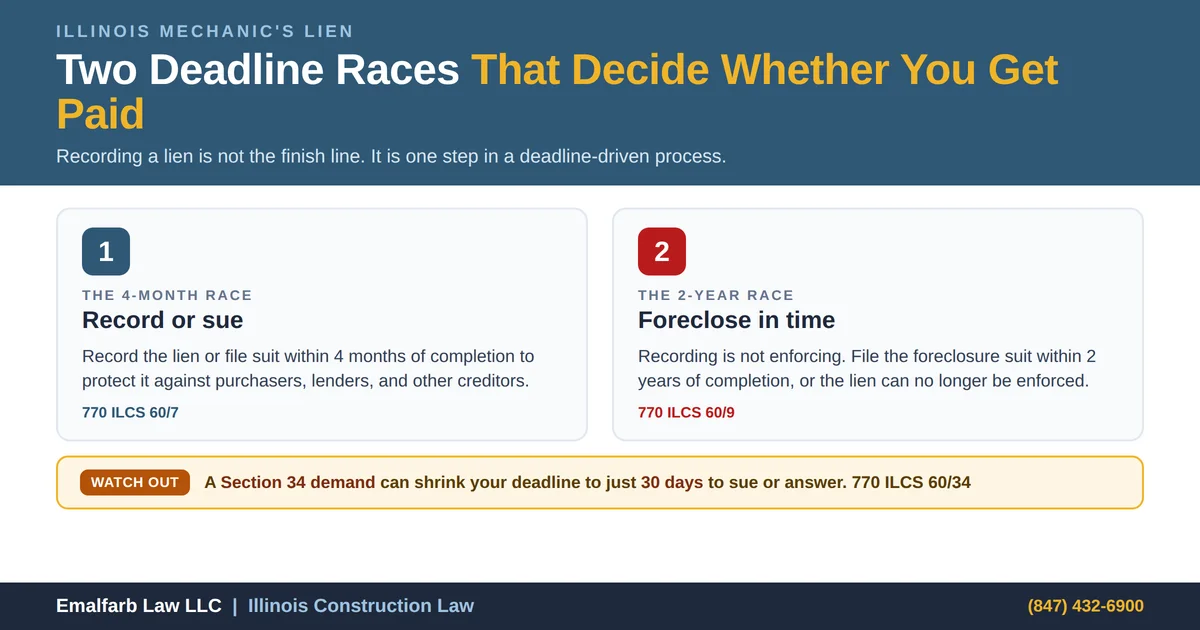
What the requirement means. For protection against other creditors, encumbrancers, and purchasers, Section 7 requires filing the claim for lien, or bringing an enforcement action, within four months after completion. The statute also addresses additional work and final delivery of additional labor, services, or materials. 770 ILCS 60/7(a). The clock itself, including how it interacts with the two-year foreclosure period, is covered in detail on our four-month recording deadline page.
The date that matters is not necessarily the date a project became financially disputed. It is the completion date of the lienable work for which the claimant seeks recovery. A claimant cannot extend the filing period by pointing to trivial, insubstantial, or collection-related activity performed after the real work was complete. Braun-Skiba, Ltd. v. LaSalle National Bank, 279 Ill. App. 3d 912, 917-20 (1996).
Pitfall. Trying to revive the deadline with nominal work. In Braun-Skiba, the evidence supported a finding that the alleged later architectural work was insignificant and did not extend the filing deadline. The claim was not enforceable against the subsequent owner.
Best practice.
- Identify the last date of substantial, contract-required, lienable work or delivery.
- Preserve contemporaneous support: daily reports, delivery tickets, pay applications, change directives, invoices, emails, and photographs.
- Calendar the conservative four-month deadline immediately. Do not wait for final negotiations, retainage discussions, or a hoped-for change order. The Illinois deadline reference at National Lien & Bond lists the four-month, 90-day, 60-day, and two-year windows by claimant role and project type.
- If extra work is relied upon, document why it was real contract work and not corrective, trivial, warranty, or collection work.
2. Verify the Claim by Affidavit
What the requirement means. Section 7 requires the recorded claim to be verified by affidavit of the claimant or the claimant's agent or employee. A signature alone is not the statutory equivalent of a verification. 770 ILCS 60/7(a).
Pitfall. Signing a lien form without an actual sworn verification. In Tefco Construction Co. v. Continental Community Bank & Trust Co., the lien contained the contract statement, the balance, and the property description, but the signer did not verify it by affidavit. The court held that the omission rendered the lien unenforceable, even though the claimant had performed the work and the opposing parties had not shown prejudice. Tefco Construction Co. v. Continental Community Bank & Trust Co., 357 Ill. App. 3d 714, 719-21 (2005).
Best practice.
- Use a verification block that makes a sworn statement that the factual contents of the claim are true.
- Confirm that the person verifying is the claimant or a properly authorized agent or employee.
- Complete the oath and notarization formalities before recording. A notary acknowledgment and a verification serve different functions, so the document should clearly contain the required sworn verification.
- Retain the executed original and a recorder-stamped copy in the claim file.
3. Include a Brief but Accurate Statement of the Contract
What the requirement means. The claim must include a brief statement of the claimant's contract. Brief does not mean vague, and it does not authorize a claimant to combine separate contracts into one inaccurate narrative. The statement should identify the contracting parties, the basic scope of work or materials, and the agreement forming the basis for the unpaid amount.
Pitfall. Describing two unrelated agreements as one contract. In Burrink Commercial Services v. New Life Covenant Church, the claimant described a purchase order and a later, independent subcontract as if the latter were merely a change order to the first. The court held that this materially inaccurate description failed Section 7's contract-statement requirement. Burrink Commercial Services v. New Life Covenant Church, 2024 IL App (1st) 220778-U, ¶¶ 15-16, 22-31. Burrink is a nonprecedential Rule 23 order and should be used for its factual illustration rather than as binding precedent.
The broader principle is settled: statutory lien prerequisites must be scrupulously observed. Connelly, 97 Ill. 2d at 246. The same principle drives the other errors that defeat recorded claims, which we catalog in Common Defects That Void an Illinois Mechanic Lien.
Best practice.
- Identify every agreement supporting the claim and determine whether it is an original contract, a genuine change order, or a separate contract.
- State the correct contracting entities, including the claimant's exact legal name and the party with whom it contracted.
- For oral agreements, state the essential agreed scope and payment basis accurately. Do not describe an oral agreement as a signed written contract.
- Attach supporting contract documents when useful, but make sure the text of the lien itself accurately identifies the agreement.
- Reconcile the contract description to the invoice, change-order log, and final claim calculation before recording.
Recording an Illinois Lien Claim?
Send us the contract, the payment history, the last date of substantial work, and the legal description you plan to use. We will confirm the four-month date, the verification, the contract statement, the net balance, and the property description before the claim is recorded. No charge for the initial assessment.
All inquiries answered within 1 business day.
4. State the Balance Due After All Credits
What the requirement means. The lien must state the balance due after allowing all credits. 770 ILCS 60/7(a). This is the net amount claimed, not simply the original contract sum or total gross billing.
Pitfall. Recording the gross contract amount or a number that omits payments, credits, back charges, or credits for unfinished work. The claim amount must be traceable to the contract and payment history. An error or overcharge does not automatically defeat a lien to its proper amount unless made with intent to defraud, but that statutory protection is not a reason to treat the claim calculation casually. 770 ILCS 60/7(a); Connelly, 97 Ill. 2d at 250-51.
Best practice. Before filing, prepare a one-page lien calculation. Each line should tie to a document in the claim file:
- Original contract amount. Executed contract or accepted proposal.
- Approved changes. Change orders, directives, or written approvals.
- Value of completed lienable work. Invoice, schedule of values, delivery tickets, or labor records.
- Payments received. Check copies, payment ledger, waivers, or remittance advice.
- Credits and offsets. Credit memos, owner back charges, and completion costs, if applicable.
- Net lien amount. Final reconciled balance after all credits.
If the claim includes interest, costs, or other additions, make clear what the stated statutory lien balance represents and confirm the legal basis before including them. Once the claim is recorded, the room to fix the number is narrow, as explained in Can You Amend a Mechanic Lien in Illinois?
5. Provide a Sufficiently Correct Property Description
What the requirement means. Section 7 requires a description sufficiently correct to identify the relevant lot, lots, or tracts. 770 ILCS 60/7(a). The statute does not demand perfection for its own sake, but the description must actually identify the property burdened by the lien.
Pitfall. Relying only on an informal address or copying a legal description without checking it against the title record. A recorded claim affects real estate title, so an incorrect parcel description can create a serious enforcement and closing problem. In Connelly, the Supreme Court found the property description adequate where the lien listed street addresses and legal descriptions for the four tracts. Connelly, 97 Ill. 2d at 246-47.
A related pitfall arises on multi-parcel projects. Section 7 permits one statement covering multiple buildings and lots when they are covered by the contract, but the four-month timing analysis can require attention to when work on each parcel was completed. 770 ILCS 60/7(b); Connelly, 97 Ill. 2d at 247-50.
Best practice.
- Obtain and compare the legal description from the most reliable available title or recorded source before recording.
- Use the legal description and add the common street address and permanent index number when available as supplemental identifiers.
- Confirm county, municipality, unit designation, and condominium legal description where applicable.
- For multiple lots or buildings, identify each parcel and document the completion date and claimed amount analysis for each one.
Strict Construction Does Not Mean Inventing Extra Requirements
The phrase strict construction is often misunderstood. It means that the statutory requirements on which lien rights depend must be followed. It does not mean a court should create additional technical filing elements that the legislature omitted.
Must the Recorded Claim State the Completion Date?
No, and that distinction is the central teaching of National City Mortgage v. Bergman. The court rejected a challenge based on the claimant's failure to place a completion date on the face of the recorded Section 7 lien. Section 7 requires timely filing, but it does not require that the claim itself recite the completion date. The court contrasted Section 7 with Section 11, which does require that date in the pleading used to enforce a lien. National City Mortgage, 405 Ill. App. 3d at 107-11.
The Illinois Supreme Court made the same point in Connelly: once the lien claimant has complied with the statutory requirements, the claimant is entitled to expect the lien to be enforceable, and strict construction is not a trap for a good-faith claimant over an immaterial misstep. Connelly, 97 Ill. 2d at 251.
Practical takeaway.
- Do strictly comply with the five statutory requirements.
- Do include a completion date as a prudent factual practice when it is accurate and supported, even though National City Mortgage holds it is not a facial Section 7 requirement.
- Do not assume that omitting a fact required only in the foreclosure pleading, rather than the recorded claim, automatically invalidates a Section 7 lien.
- Do not treat the absence of third-party prejudice as a cure for an actual statutory prerequisite. Tefco confirms that it is not.
A Pre-Recording Section 7 Checklist
Before the lien is recorded, confirm all of the following:
- The claimant has lien rights under the correct contractor or subcontractor provisions.
- Any separate preliminary, 90-day, or owner-occupied-residence notice requirements have been independently evaluated and satisfied.
- The four-month deadline against creditors, encumbrancers, and purchasers has been calculated from a supportable completion date.
- The claim contains a valid sworn verification by the claimant, agent, or employee.
- The contract statement accurately identifies the agreement or agreements, the contracting parties, and the scope supporting the claim.
- The lien amount is the net balance after every payment and credit.
- The legal description identifies the correct real estate.
- The county recorder is the county where the improvement is located.
- The claim file contains the executed lien, recording receipt, contract documents, invoices, payment ledger, and proof supporting the last lienable work.
- The foreclosure deadline and all necessary parties have been calendared separately.
The Bottom Line
Section 7 is short, but it is not casual. Timing, verification, contract accuracy, net balance, and property identification are the five recorded-claim essentials. A claimant that misses an express prerequisite risks losing a powerful statutory remedy. A claimant that satisfies those five requirements, however, should not lose the lien because an opponent proposes an extra condition that Section 7 does not contain. If you are preparing a claim for lien or defending against one, contact Emalfarb Law LLC before the four-month date passes.
Authorities Cited
- 770 ILCS 60/7
- First Federal Savings & Loan Ass'n of Chicago v. Connelly, 97 Ill. 2d 242 (1983)
- Tefco Construction Co. v. Continental Community Bank & Trust Co., 357 Ill. App. 3d 714 (2005)
- Braun-Skiba, Ltd. v. LaSalle National Bank, 279 Ill. App. 3d 912 (1996)
- National City Mortgage v. Bergman, 405 Ill. App. 3d 102 (2010)
- Burrink Commercial Services v. New Life Covenant Church, 2024 IL App (1st) 220778-U
This article is educational and reflects Illinois law as reviewed on September 9, 2026. It is not legal advice and does not create an attorney-client relationship. Mechanic's lien rights are highly fact-specific, and deadlines and notice requirements vary by claimant status, project type, property type, and the parties whose interests are affected.
Frequently Asked Questions
What are the five requirements for an Illinois claim for lien under Section 7?
A Section 7 claim for lien must satisfy five requirements. Under 770 ILCS 60/7(a), a contractor who wants the lien to be enforceable against a creditor, encumbrancer, or purchaser must, within four months after completion, record a claim for lien that is verified by affidavit of the claimant or the claimant's agent or employee, contains a brief statement of the contract, states the balance due after allowing all credits, and gives a sufficiently correct description of the lot, lots, or tracts of land to identify them. The Illinois Appellate Court listed those five items in National City Mortgage v. Bergman, 405 Ill. App. 3d 102, 108-09 (2010). Each one is a prerequisite to the lien itself, not a formality. A claim that omits any of them is exposed to a motion to dismiss no matter how well the underlying work was performed.
Does a signature on the lien form satisfy the verification requirement?
No. Section 7 requires the claim for lien to be verified by affidavit of the claimant or the claimant's agent or employee, and a signature alone is not a sworn verification. 770 ILCS 60/7(a). In Tefco Construction Co. v. Continental Community Bank & Trust Co., 357 Ill. App. 3d 714, 719-21 (2005), the recorded claim contained the contract statement, the balance due, and the property description, but the signer did not verify it by affidavit. The court held the lien unenforceable even though the claimant had performed the work and the opposing parties had not shown any prejudice. The practical consequence is that the verification block must contain a sworn statement that the contents of the claim are true, the person swearing must be the claimant or an authorized agent or employee, and the oath and notarization must be completed before the claim is recorded.
Must an Illinois claim for lien state the date the work was completed?
No. Section 7 requires the claim to be recorded within four months after completion, but it does not require the recorded claim to recite the completion date on its face. 770 ILCS 60/7(a). In National City Mortgage v. Bergman, 405 Ill. App. 3d 102, 107-11 (2010), the court rejected a challenge based on the absence of a completion date in the recorded claim and contrasted Section 7 with Section 11, which does require the completion date in the complaint used to enforce the lien. The practical consequence is twofold. A claimant should still include an accurate, supportable completion date because it removes an argument and is required later in the foreclosure pleading. An opponent, however, should not assume that a missing completion date invalidates a Section 7 claim, because the court has held that it does not.
What amount should the recorded Illinois lien claim state?
The claim must state the balance due after allowing all credits, meaning the net amount owed, not the gross contract price or total billings. 770 ILCS 60/7(a). Payments received, credit memos, approved back charges, and credits for unfinished work all reduce the figure. Section 7(a) provides that an error or overcharge does not defeat the lien to its proper amount unless it was made with intent to defraud, and First Federal Savings & Loan Ass'n of Chicago v. Connelly, 97 Ill. 2d 242, 250-51 (1983), applies that protection to a good-faith claimant. That protection is not a reason to treat the calculation casually. A claim that cannot be traced to the contract and the payment ledger invites a fraud argument and a counterclaim under 770 ILCS 60/35. Prepare a one-page reconciliation before recording, and separately identify any interest or costs so the statutory lien balance is clear.
What property description is sufficient for an Illinois mechanic's lien?
The description must be sufficiently correct to identify the lot, lots, or tracts of land subject to the lien. 770 ILCS 60/7(a). The statute does not demand perfection for its own sake, but the description has to identify the real estate actually burdened. In Connelly, 97 Ill. 2d at 246-47, the Illinois Supreme Court found the description adequate where the claim listed the street addresses and legal descriptions of the four tracts. Section 7(b) permits one claim covering multiple buildings or lots when the contract covers them, though the four-month analysis may require attention to when work on each parcel was completed. The practical consequence is that the claimant should pull the legal description from a reliable title or recorded source, add the common address and permanent index number as supplemental identifiers, and confirm the county, unit designation, and condominium description where they apply.