May 1, 2026 · Mechanic Liens
Common Defects That Void an Illinois Mechanic Lien
An Illinois mechanic lien recorded on time can still fail. The most expensive defects are not missed deadlines but errors baked into the claim itself: overstated amounts, defective property descriptions, mis-served notices, omitted defendants, and the wrong waiver.
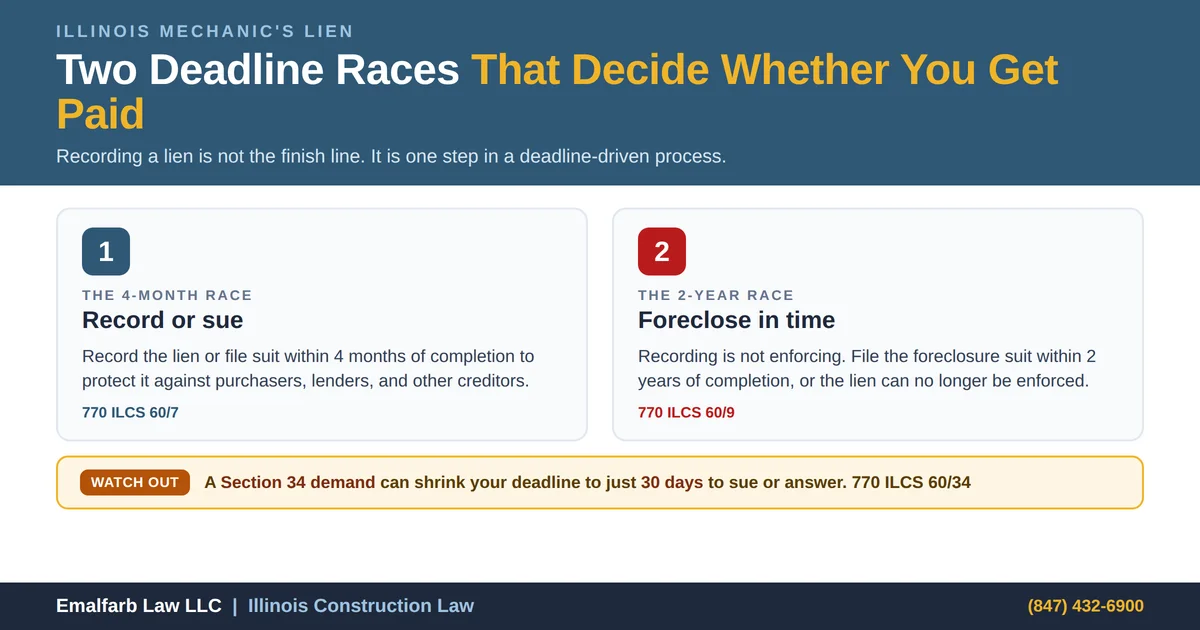
An Illinois mechanic lien recorded within the 4-month §7 window can still fail. Timely filing is necessary but not sufficient. The Mechanics Lien Act is a creature of statute, Illinois courts apply its requirements strictly, and the most expensive lien defects are not missed deadlines but errors baked into the lien claim and its surrounding paperwork. A claimant that records on day 119 of a 122-day window with a defective legal description, an overstated amount, or an unconditional waiver already signed has filed a doomed claim. The deadline was met. The lien still fails.
This article walks through the defects that void Illinois mechanic liens most often, the cases that have shaped the doctrine, and the documentation discipline that prevents them. It is a deep companion to our Illinois mechanic lien deadlines hub, which lays out every clock the Act imposes, and to the cluster posts on last day of furnishing, privity-driven classification, punch-list versus extra work, and the 2-year §9 enforcement window.
Why Strict Compliance Matters
Illinois mechanic liens are purely statutory. They did not exist at common law, and the Mechanics Lien Act creates the entire framework within which they can be claimed. First Federal Savings & Loan Ass'n v. Connelly, 97 Ill. 2d 242 (1983), reaffirmed the strict-compliance rule: every technical requirement of the Act must be satisfied because the lien is the exclusive creation of the legislature. Equitable tolling, estoppel, substantial compliance, and good-faith error generally will not save a claim that fails to meet a statutory requirement.
The strict-compliance rule cuts both ways. It protects claimants from defenses that have no statutory grounding, a defendant cannot defeat a perfect lien by arguing it is unfair, inconvenient, or commercially unreasonable. It also defeats claimants whose lien fails any element the statute imposes, regardless of how strong the underlying payment claim is. Illinois construction litigators see this pattern weekly: a contractor performed real work, was not paid, recorded a lien within the §7 window, and lost the lien on a procedural defect that could have been prevented at intake.
Defect 1: Overstated Lien Amount
Intentionally inflating the lien amount can void the claim in its entirety as constructively fraudulent. The defense scrutinizes every line item: the contract price, change orders, credits for offsets and payments received, exclusion of non-lienable items (interest, late fees, attorney fees that the contract does not authorize as lienable), and the calculation of unpaid balance.
Two categories of overstatement require careful management. Good-faith calculation errors are typically corrected by amendment or by judicial reduction without voiding the lien. The court reduces the lien amount to the proven value, awards costs against the claimant for the disputed portion, and the lien proceeds. Deliberate overstatement is treated differently. Illinois courts have voided liens in their entirety when the inflation reflected an intent to claim amounts the claimant knew it was not entitled to, a non-existent change order, charges for work not performed, or amounts the claimant knew had been paid.
The line is fact-specific and depends on documentation. A claimant that maintained contemporaneous records, applied credits as payments were received, and can produce the back-up calculation typically survives the overstatement attack even if the court ultimately reduces the amount. A claimant that recorded a round-number lien with no back-up calculation invites a §35 counterclaim.
Defect 2: Defective Legal Description
Section 7 requires the lien claim to describe the property with sufficient particularity to identify it. 770 ILCS 60/7. A street address alone is often insufficient, particularly on:
Multi-parcel projects where the work spans more than one tax parcel. A street address may identify the principal parcel but omit adjoining parcels also affected by the lien. The defense will move to limit the lien to the specifically described parcel, even if the work plainly improved the unidentified ones.
Condominium units where the unit number must be identified along with the building address and the common-elements description. A lien on a condominium unit that fails to specify the unit number can be limited to the common elements only, defeating the claim against the unit owner.
Unimproved land or new construction where street addresses may not yet exist or may not be reliably tied to the recorded parcel. The legal description from the deed or a current title commitment is the controlling identifier.
Properties recently subdivided or consolidated where the parcel boundaries on file with the recorder may differ from the operational boundaries at the project site. The recorded legal description controls.
The standard practice is to attach the legal description from the deed or a current title commitment to the recorded lien claim. Cost is minimal; the protection is substantial.
Defect 3: Unconditional Waiver Signed for Partial Payment
An unconditional waiver of lien releases lien rights immediately upon signing, regardless of whether the underlying payment is received or clears. Signing an unconditional waiver before funds clear is one of the fastest ways to extinguish lien rights in Illinois.
The mechanism is straightforward. The general contractor or owner asks the subcontractor to sign a lien waiver in exchange for a check. The subcontractor signs an unconditional waiver, accepts the check, and deposits it. The check bounces or is reversed, or the contractor stops payment. The subcontractor still has the lien-waiver problem: the waiver is effective from the date signed, not from the date funds are confirmed. The lien is gone; the unpaid balance is now an unsecured claim.
Conditional waivers solve the problem. A conditional waiver expressly conditions the release on receipt of the stated payment. If the payment does not clear, the waiver is void and the lien rights survive. Illinois practice is to use conditional waivers for every interim payment and to switch to unconditional only after funds have cleared the bank.
The waiver problem also has a partial-versus-full dimension. A partial waiver through a specific date releases lien rights only for work performed through that date and for the stated amount; subsequent work and unpaid amounts remain liened. A full waiver releases all lien rights regardless of subsequent unpaid work. Signing a full waiver mid-project, in exchange for an interim payment, can extinguish the lien rights for work that has not yet been performed and not yet been paid.
Defect 4: Section 24 Notice Served on the Wrong Owner
770 ILCS 60/24 requires the 90-day Section 24 notice to be served on the owner of record. The owner of record is determined by the public records as of the date of service, not the date of the contract or the date the work began. Mid-project ownership changes, common on developer projects, distressed properties, and estate transfers, are a frequent source of this defect.
Serving the prior owner does not satisfy the statute. Serving the general contractor does not satisfy the statute, even if the GC was the claimant's only point of contact. Serving an agent, a tenant, a property manager, or the lender of record alone does not satisfy the statute. The notice must reach the current owner of record at an address sufficient to give actual notice, by an authorized method.
The standard practice is to pull a current title report immediately before serving the notice. The cost is small. The protection is substantial. For the privity-driven framework that determines who must serve the §24 notice in the first place, see our contractor vs. subcontractor analysis.
Defect 5: Mis-Dated Last Day of Furnishing
Treating a punch-list date, a warranty callback, or a trivial visit as the last day of furnishing is the single most common substantive error in Illinois lien practice. The Illinois Supreme Court in Weather-Tite, Inc. v. University of St. Francis, 233 Ill. 2d 385 (2009), held that returning to perform corrective punch-list items does not extend the §7 last-day-of-furnishing clock. The test is whether the later work added new value to the improvement, not whether the claimant was still on site.
A claimant that calculates the §7 deadline from a punch-list date often misses the actual deadline by weeks or months. The lien is recorded after the §7 window has closed, measured from the correct earlier date. The defense moves for summary judgment on the §7 question, prevails, and the lien fails. Recording was technically perfect; the date was wrong.
Worried About a Defect in Your Lien Claim?
Send us your recorded lien, the Section 24 notice, and the contract chain. We will identify any defects that the defense will exploit and tell you whether an amendment, a re-recording, or a different remedy is the right next move. No charge for the assessment.
All inquiries answered within 1 business day.
For the full doctrinal walk-through, including change-order treatment and the trivial-work doctrine, see our punch-list versus extra-work analysis and the last-day-of-furnishing guide.
Defect 6: Omitted Defendants in the Foreclosure Complaint
The foreclosure complaint must name every party with an interest in the property. Section 11 and Illinois common law require the property owner, the lender of record, junior mortgagees, judgment creditors, other recorded mechanic lien claimants, the contractor (if the plaintiff is a subcontractor), tenants whose leasehold interests are affected, and any trustee of a deed of trust. Omitting a necessary party leaves the lien unenforceable against the missing interest.
The most common omissions: junior mortgagees recorded between the work-commencement date and the foreclosure filing, judgment creditors with recorded liens, second-position mechanic lien claimants, and trustees of deeds of trust on commercial properties. Each of these interests can be identified by pulling a current title commitment before filing the complaint.
An amended complaint adding an omitted defendant must be filed within the §9 two-year window; an amendment filed after the deadline does not relate back to the original complaint for purposes of binding the omitted party. Late-discovered omissions therefore become permanent defects, with the omitted interest surviving the foreclosure regardless of the lien claimant's prevailing on the merits against the named defendants.
Defect 7: Recording in the Wrong County
770 ILCS 60/7 requires the lien claim to be recorded with the County Recorder of Deeds in the county where the improved property is located. Recording in a different county, even an adjacent county where the claimant or general contractor maintains its principal place of business, does not perfect the lien against the property.
The defect is more common than first-time claimants assume, particularly on projects near county lines (e.g., parcels straddling Cook and DuPage, Cook and Lake, or Cook and Will), and on projects where the property address and the legal description point to different counties. Re-recording in the correct county after the §7 window has closed does not save the lien, because the §7 deadline runs to the correct recorder, not to any recorder.
Defect 8: Untimely or Defective 60-Day Residential Notice
On owner-occupied single-family residential property, the subcontractor must serve a 60-day notice on the homeowner within 60 days of the first day of furnishing. 770 ILCS 60/5(b); 770 ILCS 60/21(c). Missing the 60-day window is generally fatal to the lien, with one narrow exception: under Crawford Supply Co. v. Schwartz, 396 Ill. App. 3d 111 (1st Dist. 2009), the lien may still be valid to the extent the homeowner has not paid the contractor for the subcontractor's work between the 60-day deadline and the day the late notice arrives.
Crawford Supply is the only place in the Mechanics Lien Act where a court can weigh prejudice as a basis for excusing a deadline. Subcontractors should not treat it as a safety net. By the time the contractor has cashed the homeowner's final draw, the doctrine is gone. For the full statutory walk-through, see our 60-day residential notice guide.
Defect 9: Treating Non-Lienable Items as Lienable
Not every dollar a contractor is owed is recoverable through a mechanic lien. Lienable items are limited to the value of labor or materials actually furnished and incorporated into the improvement. Non-lienable items, interest, late fees, attorney fees not authorized by the contract as lienable, lost profit on unperformed work, mobilization costs unconnected to actual work, equipment-rental amounts beyond actual project use, should be excluded from the lien amount.
Including non-lienable items in the lien amount is treated as a form of overstatement. In good-faith cases, the court reduces the lien to the lienable portion. In cases of deliberate inclusion, the lien may be voided in its entirety as constructively fraudulent under §35.
Defect 10: Failure to Comply with the Privity-Driven Track
The Mechanics Lien Act sorts claimants into two tracks based on privity with the owner. A contractor in privity faces the §7 4-month recording deadline and the §9 2-year enforcement window. A subcontractor not in privity faces those deadlines plus the 90-day Section 24 notice and the 60-day residential notice on owner-occupied single-family work. Misclassifying a claimant, treating a subcontractor as a contractor and skipping the §24 notice, for example, is a frequent and fatal error.
The misclassification problem is more common in scenarios where the contract chain is unclear: developer projects where the GC is owned by the same parent as the developer, design-build arrangements where the architect's contract is unclear, multi-tier supply chains where the supplier sold to a sub of a sub. For the full framework, see our privity-driven classification guide.
Documentation Discipline That Prevents Defects
Most of the defects above are preventable with documentation discipline at intake and during the project. The discipline is not exotic. It is contemporaneous, scope-specific, and tied to the contract chain.
At project intake. Confirm privity and document the contract chain. Pull a title report identifying the current owner of record. Use the legal description from the deed for any lien-related document. Confirm whether the property is owner-occupied single-family residential. Calendar the 60-day residential notice deadline (if applicable), the 90-day Section 24 deadline, the 4-month §7 recording deadline, and the 2-year §9 enforcement deadline, all measured backward from a hypothetical last day of furnishing, and updated as the actual last day approaches.
During the project. Maintain daily job logs at the task level. Track change-order work separately from original-scope work. Confirm verbal change requests in writing. Sign only conditional waivers until funds clear. Apply payments to specific scope and document the application. Pull updated title reports if the project spans more than six months or if ownership signals change.
At lien recording. Pull a current title report immediately before serving Section 24 notice and again before recording the lien. Calculate the lien amount from contemporaneous records, with credits for all payments received. Use the legal description from the deed. Verify the county is correct. Verify the named owner matches the current owner of record. Calendar the §9 enforcement deadline and the internal pre-deadline review date.
At foreclosure filing. Pull a current title commitment to identify every necessary defendant. Plead every procedural prerequisite the claimant's track requires. Attach the recorded lien claim. Verify county and venue. Calendar the §34 demand window in case the owner serves a demand after the complaint is filed.
When to Consult Counsel
Three triggers warrant a quick call to a mechanic lien attorney. First, the project is ending and the contract chain or ownership of the property is unclear. Second, the contractor or owner has asked for a lien waiver in exchange for a payment that has not yet cleared. Third, a recorded lien is approaching the §9 deadline and the lien amount, legal description, or notice service is in any way questionable.
Each of those situations is fact-specific. The cost of an early consultation is small. The cost of recording a defective lien is the lien itself, the attorney fees in defending it, and frequently a §35 counterclaim seeking damages for the invalid claim.
Bottom Line
Timely filing alone does not save an Illinois mechanic lien. The Mechanics Lien Act demands strict compliance with every procedural and substantive requirement, and Illinois courts apply that demand consistently. Overstated amounts, defective legal descriptions, unconditional waivers signed for unfunded payments, mis-served Section 24 notices, mis-dated last days of furnishing, omitted defendants, wrong-county recordings, missed 60-day residential notices, non-lienable items, and privity misclassifications all defeat liens that were technically timely. Documentation discipline at intake and during the project, title reports, daily logs at the task level, conditional waivers, scope-specific payment application, and a calendar that tracks every deadline backwards from the last day of furnishing, is what separates the liens that collect from the liens that fail.
For the full deadline framework, including the calculator, county-by-county recording details, and case-law on every clock the Mechanics Lien Act imposes, see our Illinois mechanic lien deadlines hub.