May 1, 2026 · Mechanic Liens
Illinois Mechanic Lien Deadlines: Contractor vs. Subcontractor Under 770 ILCS 60
Illinois mechanic lien deadlines turn on privity, not on whether you supplied labor or materials. A direct contract with the owner puts you on the contractor track with no Section 24 notice. Any other contract puts you on the subcontractor track with the 90-day notice obligation.
Illinois mechanic lien deadlines are not determined by whether the claimant supplied labor, materials, equipment, or design services. They are determined by a single question: did the claimant have a direct contract with the property owner? That question, privity, sorts every claimant into one of two tracks under 770 ILCS 60. Each track has a different set of notice obligations. The recording and enforcement deadlines are the same, but the notice obligations are not, and a claimant who is misclassified will miss a deadline that the right classification would have caught.
This article explains the privity rule under the Illinois Mechanics Lien Act, the deadline framework that flows from it, and the common scenarios where the classification is less obvious than it looks. It is a companion to our Illinois mechanic lien deadlines hub, which lays out every clock the Act imposes. This piece explains how to figure out which clocks apply to you.
The Statutory Framework: Two Tracks, Defined by Privity
770 ILCS 60 sorts mechanic lien claimants into two categories. A claimant in direct contract with the property owner is a contractor under the Act. A claimant whose contract runs to anyone other than the owner, a general contractor, a subcontractor at any tier, a material supplier, or a developer, is a subcontractor under the Act. The labels in the parties' contracts do not control. A company called "ABC Subcontractors, Inc." that contracted directly with the owner is a contractor for §24 purposes. A company called "XYZ Supply Co." that sold materials to the GC is a subcontractor for §24 purposes.
The classification matters because the Act imposes different procedural obligations on each track. Contractors in privity with the owner are not required to serve the 90-day Section 24 notice, the owner already knows who the contractor is and what the contractor is owed. Subcontractors are required to serve the notice because the owner often has no idea they are on the job. The owner cannot demand lien waivers from people the owner does not know exist.
What the Contractor Track Looks Like
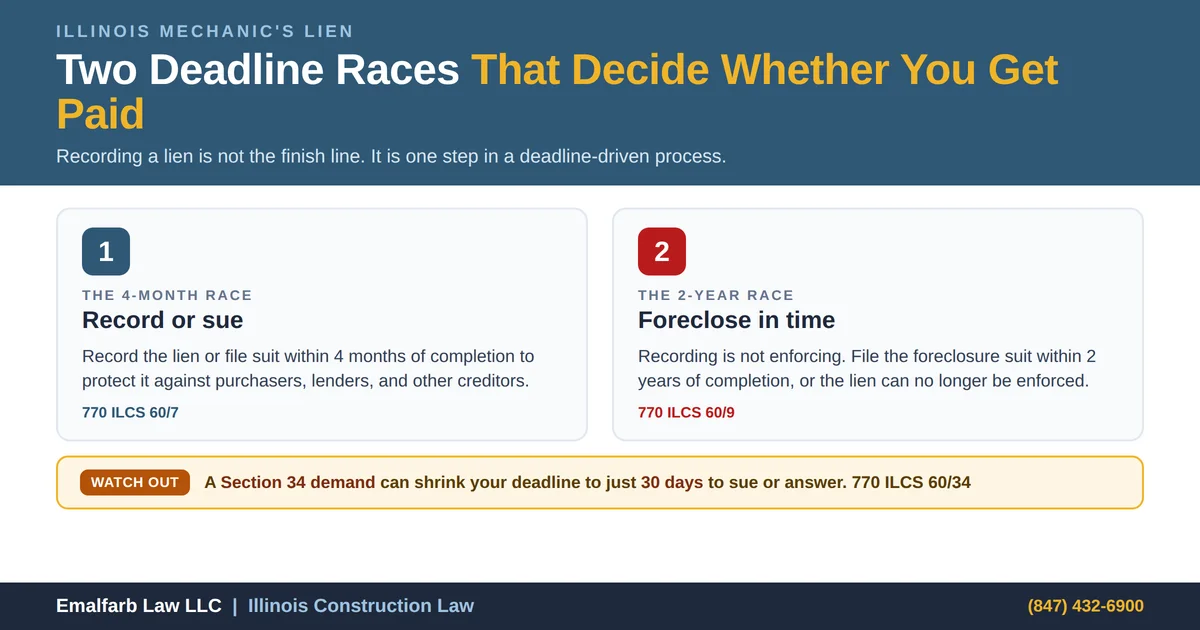
A claimant in privity with the owner faces two principal deadlines under the Act. The first is the §7 4-month recording window. The verified lien claim must be recorded with the County Recorder of Deeds in the county where the property is located within four calendar months of the claimant's last day of furnishing. 770 ILCS 60/7. Recording within this window preserves priority over subsequent purchasers, mortgagees, and judgment creditors. Recording later may still be enforceable against the owner, but loses priority against intervening third parties.
The second is the §9 2-year enforcement window. The lien claimant must file a foreclosure action in the circuit court of the county where the property is located within two years of the last day of furnishing. 770 ILCS 60/9. The two-year window can be compressed to as little as 30 days by a Section 34 demand. 770 ILCS 60/34. The contractor in privity skips the 60-day residential notice and the 90-day Section 24 notice altogether. Those obligations exist to protect the owner from claims by parties the owner did not contract with, a category the contractor is not in.
What the Subcontractor Track Looks Like
A claimant not in privity with the owner faces every deadline the contractor faces, plus two more. The first additional obligation is the 90-day Section 24 notice. 770 ILCS 60/24. The subcontractor must serve written notice on the property owner and the lender of record within 90 days of the subcontractor's last day of furnishing. The notice must identify the claimant, the amount claimed, and the nature of the work or materials furnished. Failure to serve the Section 24 notice within the 90-day window bars the subcontractor from enforcing the lien against the owner, the lender, and third parties.
The second additional obligation applies only on owner-occupied single-family residential property: the 60-day notice under 770 ILCS 60/5(b) and 60/21(c). The subcontractor must serve the homeowner with written notice within 60 days of the first day the subcontractor furnished labor or materials. The Crawford Supply prejudice rule provides a narrow safety net for late notice, but the 60-day clock should be treated as a hard deadline. For the full statutory walk-through, see our Illinois 60-day residential notice analysis.
Both notice obligations are stacked on top of the §7 4-month recording deadline and the §9 2-year enforcement deadline. The subcontractor track is therefore four-deadline architecture rather than two-deadline architecture. Missing any one of the four is generally fatal.
Material Suppliers Are Not a Separate Category
One of the most persistent confusions in Illinois mechanic lien practice is the treatment of material suppliers. The Mechanics Lien Act does not create a separate "material supplier" track. A supplier is sorted by the same privity rule that sorts everyone else.
A supplier who sold materials directly to the property owner is in the contractor track. The supplier's principal deadlines are the §7 4-month recording window and the §9 2-year enforcement window, measured from the supplier's last delivery to the project site. No Section 24 notice is required, because the owner contracted directly with the supplier and already knows the supplier exists.
A supplier who sold to a general contractor, subcontractor, or another supplier is in the subcontractor track. The supplier must serve the 90-day Section 24 notice within 90 days of the last delivery, plus the 60-day residential notice on owner-occupied single-family homes, plus comply with the §7 and §9 deadlines.
The only thing that is genuinely supplier-specific is the proof of last-furnishing date. For a supplier the date is the last delivery actually incorporated into the improvement, not the last invoice and not the last delivery returned or refused. Because supplier deliveries often finish well before project close-out, the supplier's clock typically expires sooner than the general contractor's. Calendaring backwards from the last delivery, not from project completion, is essential.
Sub-Subcontractors and Multi-Tier Chains
There is no upper limit on the tiers of subcontractors who can claim a mechanic lien in Illinois. A sub-subcontractor, a contractor hired by another subcontractor, is in the subcontractor track for §24 purposes. So is a third-tier supplier. So is a fourth-tier specialty installer. None of them are in privity with the owner; all of them must serve the 90-day Section 24 notice and (where applicable) the 60-day residential notice, regardless of how far down the chain they sit.
The practical risk in multi-tier chains is documentation. The lower the tier, the more likely the claimant has no direct correspondence with the owner, no copy of the prime contract, and no record of who the actual property owner is. Pull a current title report at the start of any project where the claimant is more than one tier removed from the owner. Serving Section 24 notice on the wrong owner of record is a defect the defense will exploit. For the cases on form-versus-substance defects in §24 notices, see our Section 24 notice case-law analysis.
Architects, Engineers, and Design Professionals
Unsure Which Deadline Track Applies to You?
Send us your contract chain, who hired you, who paid you, and what the project was. We will tell you whether you are in the contractor or subcontractor track and which notices you still have time to serve. No charge.
All inquiries answered within 1 business day.
Design professionals are sorted by the same privity rule. An architect or engineer in direct contract with the owner is in the contractor track and does not serve Section 24 notice. A design professional retained by a general contractor, construction manager, or developer is in the subcontractor track and must comply with §24. The substance of the work, drawings, specifications, project management, does not change the classification. The contract chain does.
Equipment Lessors
Illinois recognizes mechanic lien rights for parties who furnish equipment used in the improvement of the property, where the rental cost reflects use that contributed value to the improvement. The lessor's classification turns on the same privity question. A lessor who rented directly to the owner is in the contractor track. A lessor who rented to a contractor or sub is in the subcontractor track and must serve the 90-day Section 24 notice within 90 days of the last day the equipment was furnished to the project.
The Dual-Role Scenario
A single business can occupy both tracks on the same project. A drywall contractor with a direct contract with the owner for a finished basement, and a subcontract with the GC for the rest of the home's drywall, has one contractor-track scope and one subcontractor-track scope. Each scope is its own lien analysis. The basement scope skips Section 24. The GC-side scope does not. The two scopes need separate calendars, separate notices, and separate lien claims. Combining them into a single lien claim invites a defense argument that the lien is overstated as to one of the scopes.
How to Confirm Privity Quickly
When privity is unclear, work backward from the documents. Pull the proposal or estimate. Whose name is on it as the customer? Pull the change orders. Who signed them? Pull the payment records. Who issued the checks or wires? Pull lien waivers, if any. Whose name is on the receipt line? If every document points to the property owner, the claimant is in the contractor track. If every document points to a general contractor or another sub, the claimant is in the subcontractor track. Mixed documentation, for example, the owner signed the proposal but the GC issued the payments, usually means the contract is with the GC, with the owner's signature acting as project approval rather than contract formation.
Owner ratification after the fact does not convert a subcontract into a direct contract with the owner. The Illinois courts look at the contract that actually formed at the start of the work. Section 24 obligations are determined when the work begins, not when the owner thanks the claimant for a job well done.
Why Misclassification Kills Liens
The litigation pattern is consistent. A subcontractor who thought it was in privity with the owner skips the Section 24 notice. The 90-day window passes. The contractor stops paying. The subcontractor records a lien within four months of the last day of work, files a foreclosure action within two years, and only then learns from the owner's motion to dismiss that no Section 24 notice was served. The lien collapses on summary judgment because §24 is jurisdictional as against the owner, the lender, and third parties. The §7 recording was technically timely, but the gating notice was not served.
The reverse error is less catastrophic. A contractor in privity who serves an unnecessary Section 24 notice has wasted time but harmed nothing. When the privity question is genuinely close, the safer move is to treat the claimant as a subcontractor and serve the notice. The cost is a certified-mail receipt. The cost of guessing wrong the other direction is the lien itself.
Practical Calendar by Track
Contractor track (in privity with the owner): §7 4-month recording from last day of furnishing; §9 2-year enforcement from last day of furnishing; 30-day Section 34 response if served. No 60-day residential notice. No 90-day Section 24 notice.
Subcontractor track (not in privity with the owner): 60-day residential notice from first day of furnishing on owner-occupied single-family homes; 90-day Section 24 notice from last day of furnishing; §7 4-month recording from last day of furnishing; §9 2-year enforcement from last day of furnishing; 30-day Section 34 response if served.
Each track maps to a separate workflow inside the practice. Misrouting a project into the wrong workflow is the most common reason a lien fails on procedural grounds.
When to Call Counsel
Three triggers warrant a quick call to a mechanic lien attorney. First, the contract chain is unclear or undocumented and the claimant is not sure whether it is in privity with the owner. Second, the project involves dual-role scope where the same business is performing both contractor-track and subcontractor-track work. Third, a Section 34 demand has arrived and the answer to the privity question changes which deadlines were already supposed to have been met.
Each of those situations is fact-specific and time-sensitive. The cost of an early consultation is small. The cost of misclassifying a claim is the lien.
Bottom Line
Illinois mechanic lien deadlines turn on privity, not on whether the claimant supplied labor or materials. Direct contract with the owner places the claimant in the contractor track, §7 recording, §9 enforcement, no Section 24 notice. Contract with anyone else places the claimant in the subcontractor track, every deadline the contractor faces, plus the 90-day Section 24 notice, plus the 60-day residential notice on owner-occupied homes. The track determines which clocks apply. Get the track right at intake, calendar every applicable deadline backward from the last day of furnishing, and document the contract chain at the start of every project.
For the full deadline framework, including the calculator, county-by-county recording details, and case-law on the last day of furnishing, see our Illinois mechanic lien deadlines hub.