May 1, 2026 · Mechanic Liens
Illinois Mechanic Lien Last Date of Work: Punch-List, Warranty, and the 4-Month Clock
The Illinois Supreme Court drew a sharp line in Weather-Tite: punch-list and warranty work do not reset the §7 4-month recording clock. Only work that adds new value extends the last-furnishing date. Contractors who think a final visit closed out the project often misread the line.
The single most-litigated question in Illinois mechanic lien practice is whether a contractor's return visit to the jobsite reset the 4-month recording clock under §7. The Illinois Supreme Court answered the framework question in Weather-Tite, Inc. v. University of St. Francis, 233 Ill. 2d 385 (2009): only work that adds new value to the improvement extends the last day of furnishing. Punch-list, warranty, and trivial visits do not. Extra work, new scope, additional materials, additional labor that was not within the original contract, does.
That sounds clean on the page. In practice, the line between corrective work and additional work is fact-specific and often resolved only after expensive discovery. Contractors regularly record liens believing a final visit reset the clock when it did not, and they regularly miss the §7 deadline believing a final visit did not count when it might have. This article walks through the doctrine, the cases that have shaped it, the scenarios contractors face most often, and the documentation that survives a deadline challenge. It is a deep companion to our Illinois mechanic lien deadlines hub and our last-day-of-furnishing analysis.
The Statutory Frame: §7 and 'Completion'
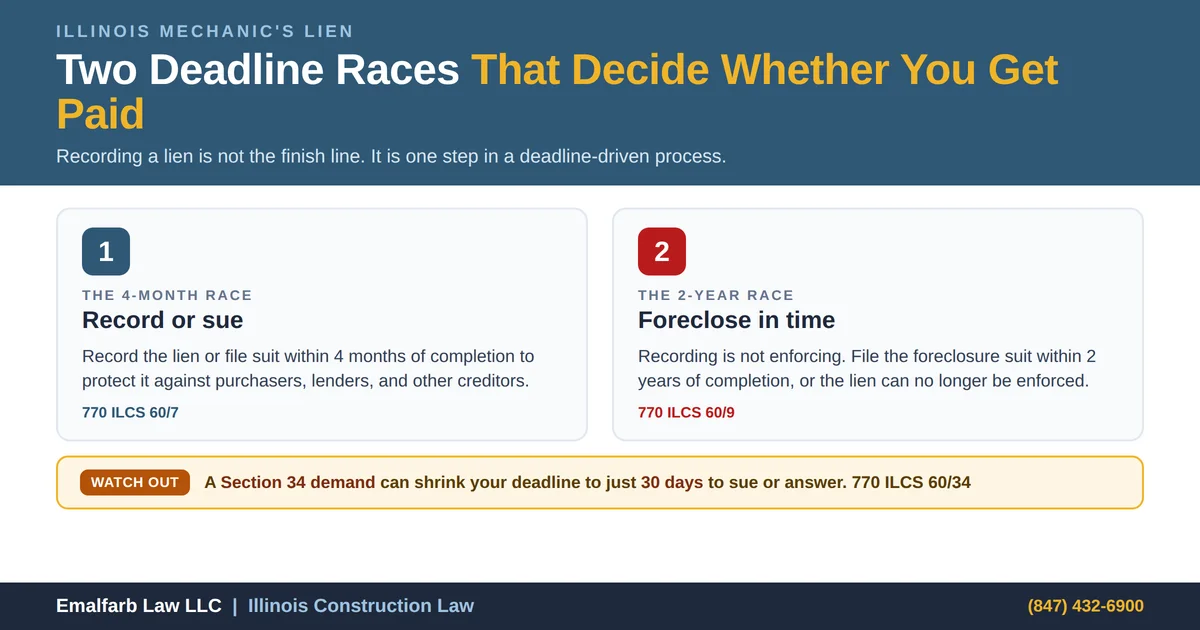
Section 7 of the Mechanics Lien Act requires a verified lien claim to be recorded within four calendar months "after completion" of the claimant's work. 770 ILCS 60/7. The Illinois Supreme Court has long read "completion" as the last day the claimant furnished lienable labor or materials to the improvement. The framework is not anchored to project substantial completion, certificate of occupancy, final invoice, or final payment. It is anchored to a conduct-based question: when did the claimant last do work that improved the property?
The conduct-based framing is what makes punch-list and warranty work problematic. A contractor that returns to fix defective work has been on site, has billed time, and has produced a punch-list sign-off. Visually it looks like work. Statutorily, it is not new furnishing. It is the contractor finishing or correcting work it was already obligated to perform under the original contract.
Weather-Tite: The Lodestar
The leading Illinois Supreme Court authority is Weather-Tite, Inc. v. University of St. Francis, 233 Ill. 2d 385 (2009). The roofing contractor completed its installation, then returned months later to perform punch-list items identified by the architect. The contractor recorded its lien within four months of the punch-list visit but more than four months after the original installation was complete. The Illinois Supreme Court held the lien untimely.
The Court drew a sharp line. The §7 clock does not run from the last time the contractor was on site, the last invoice date, or the date the contract was administratively closed. It runs from the date of the last work that added new value to the improvement. Punch-list items, by their nature, correct or complete work the claimant was already obligated to perform. They do not add new value. They do not extend the clock.
Weather-Tite is the analytical starting point for every contemporary Illinois deadline dispute. The doctrinal question, did the later work add new value, or did it merely complete or correct what the contract already required?, is the same question Illinois courts ask in every fact pattern that has emerged since.
The Punch-List Category
Punch-list items are the most common factual scenario the doctrine governs. An architect or owner walks the project, identifies items that need correction or completion, and issues a list. The contractor returns to address the list. The §7 clock generally does not extend.
The reason is structural. A punch list, by definition, identifies work the contractor was supposed to have finished or finished correctly. The list might include a misaligned door, a missing trim piece, a paint touch-up, a faulty light fixture, or an unfinished caulk line. Each item is a deficiency in the original contract performance. Curing the deficiency completes work the contractor was already obligated to perform. It does not introduce new value to the improvement.
The exception is when a punch-list document is misnamed. If the so-called "punch list" actually itemizes additional scope, items the owner asked to be added that were never within the original contract, the analysis follows the substance, not the label. A signed change order embedded in a punch-list document and adding new value to the improvement extends the clock to the date that change-order work was completed.
The Warranty and Callback Category
Warranty repairs and callback visits sit in the same bucket as punch-list items. A subcontractor that returns six months after substantial completion to fix a leaky window, repair a malfunctioning HVAC system, or remediate a finish defect is performing under the warranty obligation in the original contract. The visit does not constitute new furnishing.
Illinois courts uniformly hold that warranty callbacks do not extend the §7 deadline. The same rule applies to inspection visits, equipment retrieval, post-completion site walks, and final "close-out" visits where no substantive labor or materials are furnished. None of those activities adds new value to the improvement. They are administrative wrap-up of work already performed.
Practitioners occasionally argue that warranty work "counts" because the contract obligated the claimant to perform it. The argument confuses contractual obligation with statutory definition. The Mechanics Lien Act is a creature of statute, and the §7 clock measures statutory furnishing, work that adds new value, not contractual scope.
The Trivial-Work Doctrine
Illinois courts have also recognized a trivial-work doctrine that prevents claimants from manufacturing a later last-furnishing date by returning to the site to perform de minimis tasks for the purpose of restarting the clock. Sweeping a jobsite, retrieving tools, signing off on inspections, attending a final walk-through, or stamping documentation are not lienable furnishing. The work must be substantive and of real value to the improvement.
Cordeck Sales, Inc. v. Construction Systems, Inc., 382 Ill. App. 3d 334 (1st Dist. 2008), addressed the related question of when a project is "completed" for §7 purposes and reinforced that the analysis is substantive, not formal. A claimant that records a lien based on the date of a trivial visit invites a Section 34 demand and a quick dismissal. The defense playbook is straightforward: depose the project manager and the worker who performed the alleged last-day work, establish that no substantive labor or materials were furnished that day, and move for summary judgment on the §7 question.
The Extra-Work Category
Extra work is the affirmative side of the doctrine. Work performed under a written change order, work that adds new scope, new materials, or new labor that was not within the original contract, adds new value to the improvement. That work extends the last-furnishing date to the date the change-order work was completed.
The keyword is "new." A change order for additional rooms, additional finishes, an upgraded mechanical system, additional structural elements, or new fixtures adds value. A change order that simply describes corrective work to remediate a defect in the original installation does not reset the clock; it merely papers over warranty or punch-list scope. Illinois courts examine the substance of the change-order work, not the label, and not the dollar amount.
Two practical points follow. First, the change order should be in writing, signed by an authorized agent of the owner or the contractor that hired the claimant, and tied to a defined scope. Oral change orders rarely survive a deadline challenge because the substance of the work is hard to prove without a contemporaneous record. Second, the change-order work should be tracked separately in daily logs and pay applications. A claimant that lumps change-order labor into general project hours hands the defense an easy argument that no separate "furnishing" actually occurred, that the so-called change-order work was always part of the original scope and is therefore corrective rather than additional.
Hard Cases at the Margin
Wondering Whether Your Final Visit Counts?
Send us your daily logs, change orders, and a description of the last visits to the site. We will tell you whether your last day of furnishing supports the lien, or whether the §7 clock already expired. No charge for the assessment.
All inquiries answered within 1 business day.
The doctrine produces clean answers at the extremes. A contractor returning to add a new addition to the home is doing extra work. A contractor returning to repaint a wall it painted poorly is doing punch-list work. The hard cases live in the middle.
Owner-requested touch-ups. The owner, after substantial completion, asks the contractor to make minor changes, adjust a faucet height, swap a light fixture for one the owner now prefers, repaint a hallway in a different color. If the changes are within the original contract scope (a paint color the owner specified initially and now wants reversed), the visit is corrective. If the changes are outside the original scope (a fixture upgrade the owner did not originally order), the visit is extra work, but only if documented through a written change order or written request that defines the new scope.
Mid-project change orders that bleed into close-out. A change order is signed mid-project for additional work. Some of the change-order work is performed alongside the original scope; some is finished weeks after substantial completion of the original scope. The §7 clock for the change-order work runs from the date the change-order work itself was completed. The claimant has two clocks running in parallel, one for the original scope, one for the change-order scope, and may need to record one lien covering both at the later of the two dates.
Re-doing a contractor's own poor work. A contractor that returns to re-do work it performed incorrectly the first time is performing corrective work, not extra work. The §7 clock runs from the original installation date, not the re-do date. The fact that the contractor billed for the re-do, or that the owner accepted the re-do as the final product, does not convert corrective work into new furnishing.
Substantial completion versus final completion. Many Illinois construction contracts distinguish substantial completion (the project is usable for its intended purpose) from final completion (every punch-list item is closed). The §7 clock typically aligns with substantial completion of the claimant's scope, not final completion. Final completion is the close-out of corrective items, which by definition does not add new value to the improvement.
Documentation: What Survives a Deadline Challenge
The burden of proving the last day of furnishing rests on the claimant. The court will not credit conclusory affidavits or after-the-fact reconstructions when contemporaneous records exist (or should have existed). Practitioners who litigate these disputes year after year see the same documentation gaps and the same defense playbook every time.
Documentation that survives a challenge is contemporaneous, dated, specific, and tied to scope. Daily job logs identifying the date, the workers on site, and the specific tasks performed. Change orders signed before the work begins, defining new scope and tying it to a price. Pay applications with line-item descriptions matching labor and materials to specific scope (original vs. change-order). Time sheets matching workers to project hours by scope. Date-stamped photographs showing the work in progress. Email correspondence requesting and approving the work, particularly any change requested verbally and confirmed in writing.
Documentation that does not survive: invoices generated weeks after the work was performed, summary affidavits without supporting records, "reconstructed" daily logs prepared in anticipation of litigation, and oral change-order claims unsupported by contemporaneous email or text. Defense counsel will subpoena the underlying records. The gap between the contemporaneous documentation and the affidavit becomes the heart of cross-examination.
For a complete deadline-evidence checklist, see our Illinois mechanic lien deadlines hub and the last-day-of-furnishing analysis.
How the Doctrine Interacts With Other Deadlines
The punch-list versus extra-work distinction does not just affect the §7 4-month recording deadline. It affects every deadline that runs from the last day of furnishing. A misclassification cascades through the entire filing.
If the claimant is a subcontractor, the 90-day Section 24 notice runs from the last day of furnishing. 770 ILCS 60/24. A subcontractor that treats a punch-list visit as the last day of work serves the Section 24 notice 90 days later, but the actual statutory clock ran from an earlier date, and the notice arrives weeks or months out of time. On owner-occupied single-family residential work, the 60-day residential notice runs from the first day of furnishing, but the lien itself is still controlled by the corrective-versus-additional analysis at the back end. For the privity-driven framework that determines which notices apply, see our contractor vs. subcontractor analysis.
The 2-year §9 enforcement deadline is also pulled from the same date. A claimant that miscalculates the last day of furnishing on the front end may file a foreclosure action that the defense argues is untimely on the back end.
What Defense Counsel Looks For
The defense playbook on the punch-list/extra-work question is consistent. The first attack is documentary: subpoena the daily logs, time sheets, pay applications, and change orders, and look for the gap between the alleged last day and the last contemporaneous record of substantive scope work. The second attack is substantive: argue that the alleged last-day work was punch-list, warranty, or trivial under Weather-Tite. The third attack is cross-examination: depose the project manager, the foreman, and the workers about what actually happened on the alleged last day, with the goal of establishing that the work was corrective.
Counter-strategies start at the project intake. A claimant that maintains daily logs from day one, signs delivery tickets at the site, tracks change-order work separately, and confirms verbal change requests in writing has the records to defeat each line of attack. A claimant that did not, and there are many, needs to be candid with counsel about the documentation gaps before recording the lien. A weak last-day record is better addressed before a Section 34 demand forces the issue than after.
Tactical Takeaways
The doctrine has produced a small set of tactical moves that mature Illinois lien practitioners use routinely. First, calendar two §7 dates: the substantial-completion date of the original scope and the last-day date of any change-order work. Treat the earlier date as the operative deadline unless the change-order documentation will withstand summary judgment. Second, get every change-order request in writing before the work starts. A two-line email from the owner or GC asking for additional scope, with the contractor's confirmation and price, is enough; an oral request is not. Third, keep daily logs at the task level. "Worked 8 hours" loses to "installed two new bathroom fixtures (Change Order #3, $1,400)." Fourth, when in doubt about whether late work qualifies as extra work, record from the earlier date. A timely lien from the earlier date is enforceable. A late lien from the later date that is challenged on the punch-list question may not be.
When to Consult Counsel
Three triggers warrant a quick call to a mechanic lien attorney. First, the project is closing out and the contractor has been performing both punch-list and additional work in the same time window. Second, a Section 34 demand has arrived and the §7 timeliness depends on whether a return visit qualified as extra work. Third, the owner or GC is arguing that the contractor's last day was earlier than the contractor believes, and the parties are negotiating a payoff that the timeliness analysis affects.
Each of those situations is fact-specific and time-sensitive. The cost of an early consultation is small. The cost of recording a lien on a contestable punch-list versus extra-work record is the lien, the attorney fees, and frequently a counterclaim under 770 ILCS 60/35 for damages caused by an invalid claim.
Bottom Line
Weather-Tite drew the line and Illinois courts have applied it consistently for fifteen years. Returning to the site is not enough. Billing for the visit is not enough. The contract being technically open is not enough. The §7 clock runs from the date the claimant last performed work that added new value to the improvement. Punch-list, warranty, and trivial visits do not reset the clock. Extra work documented through written change orders does. The doctrine rewards contemporaneous documentation and punishes after-the-fact reconstruction. Calendar from the earlier date when the analysis is close. Record on time. Litigate the close cases only when the documentation will hold up.
For the full deadline framework, including the calculator, county-by-county recording details, and case-law on every clock the Mechanics Lien Act imposes, see our Illinois mechanic lien deadlines hub.