May 1, 2026 · Mechanic Liens
Illinois Mechanic Lien 2-Year Foreclosure Deadline (770 ILCS 60/9)
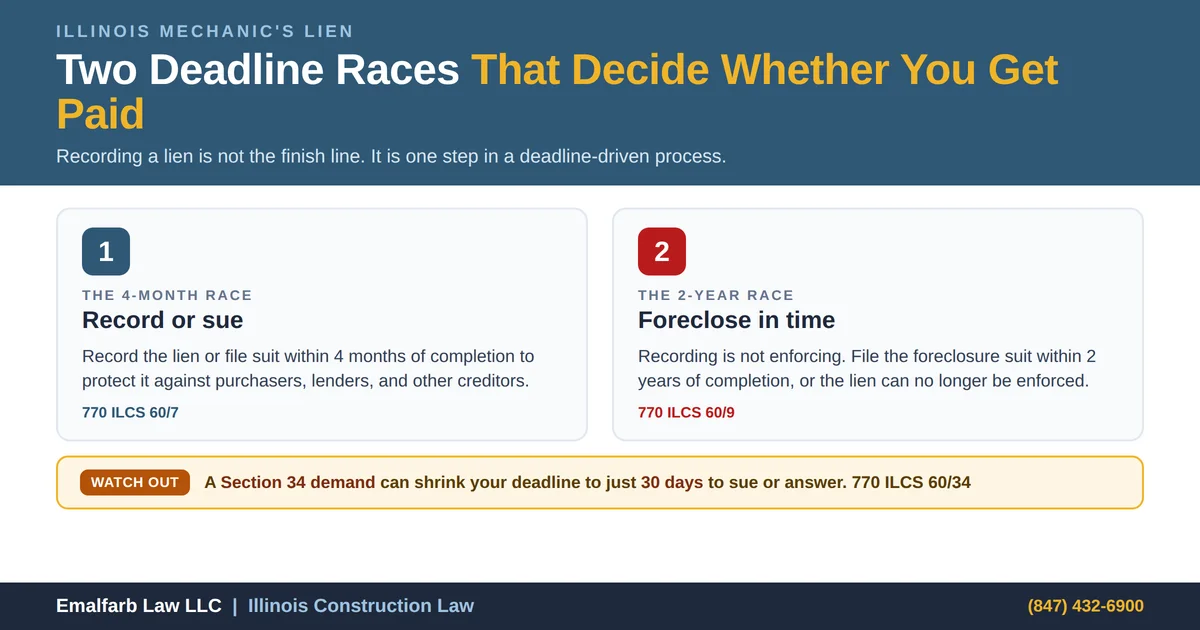
Recording an Illinois mechanic lien within four months preserves the claim. Enforcing it is a separate deadline. The §9 foreclosure complaint must be filed within two years of the last day of furnishing, or the lien expires.
Recording an Illinois mechanic lien is necessary to preserve the claim. It is not enough to enforce it. Under 770 ILCS 60/9, the lien claimant must file a foreclosure complaint in the circuit court of the county where the property is located within two years of the claimant's last day of furnishing labor or materials. Miss the §9 enforcement deadline and the lien expires by operation of law, regardless of how perfect the recording was. The two-year window can be compressed to as little as 30 days by a Section 34 demand from the owner or a title insurer.
This article walks through the §9 enforcement deadline, what the foreclosure complaint must allege, who must be named as defendants, the cases that have shaped the doctrine, and the tactical issues that commonly determine whether a claimant collects on a recorded lien or watches it expire on the property record. It is a deep companion to our Illinois mechanic lien deadlines hub.
The Statutory Frame: §7 and §9
Two sections of the Mechanics Lien Act work in tandem. Section 7 sets the 4-month recording window, also measured from the last day of furnishing. 770 ILCS 60/7. Section 9 sets the 2-year window for filing the foreclosure complaint that actually enforces the lien. 770 ILCS 60/9. Both deadlines run from the same date, the claimant's last day of furnishing labor or materials, and neither pauses based on the other.
The architecture matters because contractors regularly assume that recording the lien is the principal procedural hurdle and that the foreclosure complaint can wait while settlement negotiations proceed. It can wait, but only for two years. After that, the lien expires whether or not the claimant has been negotiating, whether or not the parties have a tolling agreement, and whether or not the contractor is in active mediation. The §9 clock is not suspended by good-faith dealing.
How the §9 Clock Is Measured
Like the §7 clock, the §9 clock runs from the last day the claimant furnished lienable labor or materials to the improvement. The last day is determined by the same conduct-based test that governs §7: the work must have added new value to the improvement, not merely completed or corrected work the claimant was already obligated to perform under the original contract. For the deeper analytical framework, see our last-day-of-furnishing analysis and punch-list versus extra-work guide.
Practical consequences follow. First, an error in identifying the last day of furnishing affects both deadlines. A claimant that miscalculates the last day on the front end may file a foreclosure complaint that the defense argues is untimely on the back end, even if the four-month recording was technically saved by the same miscalculation. Second, the recording date and the foreclosure-filing date can be more than a year apart. A claimant that records on day 100 and files foreclosure on day 700 is timely under both sections. A claimant that records on day 100 and files foreclosure on day 731 is not.
Section 34: The Acceleration Mechanism
The single most common way a two-year window collapses is a Section 34 demand. Under 770 ILCS 60/34, any person interested in the property, typically the owner or a title insurer, can serve a written demand on the lien claimant by registered or certified mail requiring suit to be filed within 30 days. If the claimant fails to file the foreclosure complaint within that compressed window, the lien is forfeited by operation of law and the claimant forever loses the right to enforce the recorded claim.
Section 34 is heavily used in title-clearing transactions. A property owner attempting to refinance, sell, or close on a transaction encounters the recorded mechanic lien on the title commitment. The title insurer or buyer's counsel demands that the lien be released or that suit be commenced quickly so the cloud on title can be resolved. The mechanism exists to prevent indefinite limbo where a recorded lien sits on title for two years while the parties pursue settlement.
Three operational details govern §34 practice. First, the demand must be in writing and served on the claimant by registered or certified mail; informal demands by phone or email do not start the 30-day clock. Second, the 30 days run from the date of service on the claimant, not the date the demand was mailed. Third, a timely-filed foreclosure complaint preserves the lien even if service on the defendants takes longer; the §34 clock is satisfied by filing, not by service. For a deeper walk-through of §34 practice, see our Section 34 demand guide and the Section 34 case-law analysis.
Section 34 is the reason mature lien practitioners do not rely on the full two-year window as a planning horizon. A demand can compress two years to thirty days at any moment.
What the Foreclosure Complaint Must Allege
The foreclosure complaint must establish each element of the lien claim. The claimant's identity and capacity to sue. The owner's identity and the legal description of the property. The contract or agreement under which the work was performed, including any change orders. The dates of first and last furnishing. The amount due, with credits for offsets and payments received. The recording of the verified lien claim, with the recorder's stamp date and document number. Service of the 90-day Section 24 notice (if the claimant is a subcontractor) and the 60-day residential notice (if applicable). Compliance with every other procedural prerequisite the Act imposes on the claimant's track. For the privity-driven framework that determines which prerequisites apply, see our contractor vs. subcontractor analysis.
The complaint typically requests an order foreclosing the lien, judicial sale of the property, distribution of proceeds in priority order to satisfy the lien and the claims of other lien claimants, and, where the underlying contract authorizes it, attorney fees and costs under 770 ILCS 60/17. In actions brought against owner-occupied single-family residences, additional procedural protections apply.
Pleading rigor matters. The defense will scrutinize every element. A complaint that omits the date of last furnishing, mis-describes the property, omits a necessary defendant, or fails to attach the recorded lien claim invites motions to dismiss that, if granted after the two-year deadline, cannot be cured by an amended complaint, because the amendment does not relate back to a complaint that failed to state a claim.
Necessary Defendants
Section 11 and Illinois common law require every party with an interest in the property to be named as a defendant in the foreclosure action. The list is longer than first-time lien plaintiffs expect. The property owner, of course. The lender of record on any mortgage encumbering the property. Junior mortgagees, if any. Other recorded mechanic lien claimants. Judgment creditors with recorded liens. The contractor (if the plaintiff is a subcontractor in the subcontractor track). Any tenant whose leasehold interest the foreclosure affects. The trustee of any deed of trust against the property.
Pulling a current title commitment before filing is the standard practice. The commitment identifies every recorded interest as of the search date and is the primary tool for assembling the defendant list. Filing without a current commitment, and learning during the case that a junior mortgagee was omitted, often forces an amended complaint after the two-year deadline. The amendment may still be granted, but the omitted party will argue, often successfully, that its interest is unaffected by the amended complaint because the original complaint did not name it within the §9 window.
Priority and the Relation-Back Doctrine
Recording within the §7 4-month window is what preserves priority. Under §1 and §7 read together, a timely-recorded mechanic lien relates back to the date the claimant's contract was entered into or work began, giving the lien priority over any mortgage, judgment, or other encumbrance that attached after that date but before the lien was recorded. Cordeck Sales, Inc. v. Construction Systems, Inc., 382 Ill. App. 3d 334 (1st Dist. 2008).
2-Year Deadline Approaching?
Send us your recorded lien, the date of last furnishing, and the contract chain. We will tell you whether you are still in time to file foreclosure, and whether a Section 34 demand has secretly compressed your window. No charge.
All inquiries answered within 1 business day.
The §9 foreclosure complaint enforces the priority that the §7 recording preserved. Filing the complaint within two years protects the priority advantage; filing late forfeits it. A late-filed lien that loses §9 timeliness loses the relation-back priority along with the lien itself, even if the recording would otherwise have been timely.
Among multiple timely-recorded mechanic lien claimants, Illinois law does not rank by filing order. All timely-recorded mechanic liens share equal priority and are satisfied pro rata from available proceeds if the property is sold through foreclosure. The competition is therefore not among lien claimants for first position; it is between lien claimants as a class and other secured creditors whose interests attached at different points on the priority timeline.
When the Foreclosure Should Be Filed Earlier Than Two Years
Mature lien practitioners frequently file foreclosure well before the two-year deadline. Three considerations drive earlier filing.
First, Section 34 risk. A demand from the owner or title insurer can compress the two-year window to 30 days at any moment. Filing earlier locks in the foreclosure schedule and removes the risk that a late-arriving demand will catch the practice unprepared.
Second, settlement leverage. A recorded lien creates a cloud on title; a filed foreclosure action creates active litigation, depositions, and the prospect of judicial sale. Owners who would not respond to demand letters tend to engage seriously when the foreclosure complaint is filed and discovery begins.
Third, factual preservation. Witnesses leave companies. Documents are misplaced. Foremen retire. The longer the gap between the last day of furnishing and the foreclosure filing, the harder it becomes to assemble the proof the case requires. Filing earlier preserves the ability to take the depositions and pull the documents that will determine the case's outcome.
When Foreclosure Should Wait
There are also reasons to wait, though they are narrower than first-time claimants assume. A pending settlement negotiation that is genuinely converging on a payment can justify a delay, particularly if the parties have signed a tolling agreement that addresses the §9 deadline (recognizing, however, that Illinois courts have consistently held that tolling agreements cannot extend the statutory enforcement period, see the FAQ on contractual extension). A bankruptcy filing by the owner triggers an automatic stay that pauses litigation; the §9 deadline does not pause, but the foreclosure cannot proceed until the stay is lifted, which has implications for filing timing. A short-term forbearance during which the contractor expects to be paid in full can occasionally justify holding off, though if the payment does not arrive, the calendar must include a hard cutoff that leaves enough time to file before the §9 window closes.
In all of those cases, the calendar entry should mark the §9 deadline minus 60 to 90 days, not the deadline itself. Last-minute filings invite procedural defects that can defeat the lien.
Common Defects in Foreclosure Complaints
The defense playbook is well-developed. The first attack is procedural: scrutinize the recording date, the §9 filing date, the §24 notice date (if applicable), and the §5/21 60-day residential notice date (if applicable), and identify any deadline that was missed. The second attack is documentary: subpoena the daily logs, time sheets, and pay applications, and challenge the alleged last day of furnishing. The third attack is pleading: move to dismiss for failure to attach the recorded lien claim, failure to state the contract terms, failure to identify necessary defendants, or failure to plead compliance with every procedural prerequisite the claimant's track requires.
The most common defects in pro se or under-resourced filings: mis-describing the property by street address only when the legal description controls; omitting the lender of record from the defendant list; failing to plead and attach the §24 notice on a subcontractor case; and pleading the last day of furnishing as the punch-list date when the analysis would not survive Weather-Tite.
Tactical Calendar
Mature lien practices keep three §9-related dates on the calendar from the moment a lien is recorded. The §9 absolute deadline (two years from the last day of furnishing). The §9 internal deadline (90 days before the absolute deadline, to allow for pleading and title work). The §34 trigger date (the day a demand might arrive, with a 30-day countdown ready to activate).
When a §34 demand arrives, the practice activates the 30-day countdown immediately. Title commitments are pulled, the complaint draft is finalized, and filing occurs well before day 30. When the §9 absolute deadline approaches without a settlement, the internal deadline triggers preparation regardless of the state of negotiations. Filing on day 729 of a 730-day window is malpractice exposure; filing on day 660 is professional practice.
When to Consult Counsel
Three triggers warrant a quick call to a mechanic lien attorney. First, the recorded lien is approaching the §9 two-year deadline and no settlement is in sight. Second, a Section 34 demand has arrived. Third, the contractor is contemplating a tolling agreement or other contractual mechanism intended to extend the §9 window, which Illinois courts will not enforce, but which often signals that the deadline is closer than the contractor realized.
Each of those situations is time-sensitive. The cost of an early consultation is small. The cost of letting the §9 clock run is the lien itself.
Bottom Line
Recording an Illinois mechanic lien is necessary but not sufficient. Section 9 imposes a two-year window for filing the foreclosure complaint that actually enforces the recorded claim, measured from the same last-day-of-furnishing date that governs §7. Section 34 can compress the window to 30 days at any moment. Filing the complaint requires a current title commitment, every necessary defendant, careful pleading of every procedural prerequisite, and a county-specific filing in the circuit court where the property is located. Mature lien practitioners file well before the absolute deadline because §34 risk, settlement leverage, and factual preservation all favor earlier action.
For the full deadline framework, including the calculator, county-by-county recording details, the §7 4-month recording analysis, and the Section 34 acceleration mechanism, see our Illinois mechanic lien deadlines hub.