October 12, 2026 · Factoring & UCC
When a Factored Account Goes Unpaid: Recovery Steps
When a purchased invoice goes unpaid, a well documented factoring program may provide claims against more than one party. Here is the recovery sequence: check bankruptcy status, find where the money went, give the seller and each guarantor the required notice and demand, send UCC 9-406 demands where payments did not discharge the assigned obligation, and sue and enforce when demand fails.
A factoring default rarely announces itself. A purchased invoice ages past terms, the seller stops answering calls, and then an account debtor reports that it already paid, to the seller or to a new bank account it was told to use. By the time the problem is clear, the payoff balance can be significant and the seller's own assets limited.
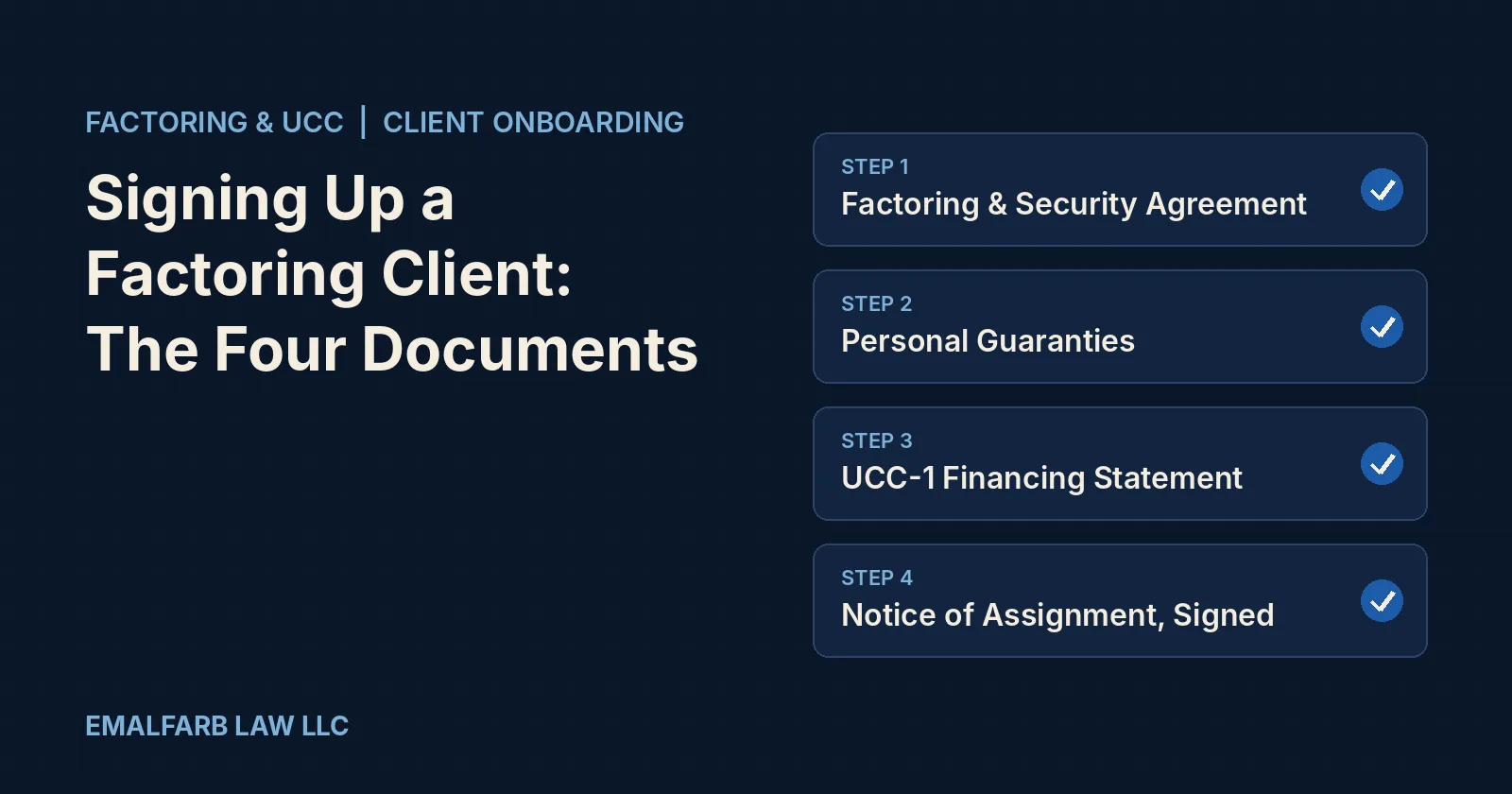
A well documented program may provide claims against more than one party. This article explains what happens when a factored account goes unpaid, in the order we typically approach it. It assumes the core documents described in our article on signing up a factoring client are in place. If they are not, recovery may still be possible, but the analysis changes.
First, Check Bankruptcy Status
Before sending demands or taking enforcement action, check whether the seller, any guarantor, or a key account debtor has filed bankruptcy. A filing stays specified collection, litigation, and lien-enforcement acts against the debtor and acts involving property of the estate under 11 U.S.C. § 362(a). Where the factor claims to have purchased receivables outright, the transaction and any relevant court orders must be analyzed before collection continues, because the characterization of the transaction as a true sale or a secured financing can affect whether the receivables are estate property.
Then, Determine Where the Money Went
An unpaid purchased account falls into one of three categories. It is still owed and unpaid, it is disputed, or it was paid to someone other than the factor. Each calls for a different response, so the next task is to determine which applies to each open invoice.
The factor should contact each account debtor's payables department, confirm the status of each purchased invoice, and request remittance advices for anything shown as paid. Account debtors are often cooperative at this stage, and their records frequently show where payments were directed.
- Still owed and unpaid: the account debtor may be directed in writing to pay the factor, under the existing notice of assignment and the factor's collection rights under UCC § 9-607, as the agreement and the statute permit
- Disputed: the factor takes the account subject to the account debtor's transaction defenses under § 9-404; notice changes the proper payment recipient but does not establish that the work was performed or the invoice approved, so breach-of-warranty or guaranty remedies against the seller and guarantors may need to be evaluated, depending on the agreement and the scope of each guaranty
- Paid to the seller after notice: if the payment came after the account debtor received an effective notification, the payment generally does not discharge the assigned obligation under § 9-406(a), subject to proof requests, defenses, and statutory exceptions
Evaluate Funding and Document the Default
Evaluate suspension or termination of funding under the factoring and security agreement, any applicable notice requirements, and any insolvency proceeding. The agreement should list the events of default that apply, such as diverted collections, invoices that do not reflect completed work, duplicate financing, changed remittance instructions, insolvency, and guarantor default. Once the conduct is confirmed, give any notice the agreement requires.
Calculate the balance from the agreement and the supporting transaction records. A payoff calculation is evidence, not a binding damages determination; any demand must account for purchases, collections, reserves, credits, repurchases, fees, and other adjustments the agreement and applicable law permit.
Notices and Demands to the Seller and Each Guarantor
The seller and each principal who signed a personal guaranty should receive the notice and demand their documents require, at the address and by the method each specifies. Even where notice is waived, a separate written demand to each guarantor documents the claim. Whether a notice triggers liability or starts a cure period depends on the contract.
A formal attorney demand to the seller and the guarantors typically follows, identifying the factoring agreement, the guaranties, each default, and the balance claimed, with the supporting records. A guarantor's liability depends on the guaranty's scope, caps, triggers, and defenses; ownership of the seller does not by itself make an individual liable.
The Section 9-406 Demand to Account Debtors
For many factors, a demand to account debtors whose payments did not discharge the assigned obligation is an important part of the recovery. Under UCC § 9-406(a), adopted in Illinois at 810 ILCS 5/9-406(a), after receipt of the notification, the account debtor may discharge its obligation by paying the assignee and may not discharge it by paying the assignor. The factor must still establish the assignment, effective notification and receipt, the underlying obligation, and the recoverable balance. The account debtor owes the assigned receivable, not the seller's entire payoff balance.
Our demand to an account debtor is built on the records:
- The executed assignment provisions and the invoice-level purchase records connecting each disputed invoice to the assignment
- A payment schedule identifying each purchased invoice, its amount, and the payments the account debtor made
- The notice of assignment and evidence of its delivery and receipt, including any signed acknowledgment
- Remittance advices or correspondence showing payment to the seller, or to a changed account, after notice
- The relevant underlying contract terms and performance records
Two arguments come up repeatedly. The first is an anti-assignment clause in the account debtor's own contract; for ordinary commercial accounts, § 9-406(d) generally makes contractual restrictions on assignment of the payment right ineffective, subject to exceptions, federal law, and special receivable rules. The second is a request for proof under § 9-406(c). Until the factor seasonably furnishes reasonable proof, the account debtor may pay the seller. Respond promptly with the executed purchase or assignment provisions, the applicable purchase schedule or invoice-level purchase record, and evidence connecting the disputed accounts to the assignment. A UCC filing may corroborate the financing relationship but does not, by itself, establish the purchase of particular invoices.
Conflicting Payment Instructions and Payment Fraud
A common variation is the account debtor that receives conflicting instructions: the factor's notice on one hand, and a letter or email directing payment to a new account on the other. Many account debtors hold payment until the conflict is resolved.
Conflicting or changed payment instructions require immediate verification. Where the seller itself redirected payment, a payment to the seller after effective notification generally does not discharge the assigned obligation. Where an impostor or compromised email account is involved, responsibility must be evaluated under the assignment documents, the payment facts, and applicable law; those situations are not necessarily treated the same way. Bank-account changes should be verified through a previously established telephone number or other trusted channel, not the contact information supplied in the change request.
Negotiated Resolutions
Many matters resolve before suit. If the seller or its guarantors propose a payment arrangement, it should be in a signed writing that states the agreed balance, preserves every guaranty, and provides for default and acceleration. Where lawful and appropriate, counsel may evaluate a stipulated or consent judgment and a related enforcement procedure. Confession-of-judgment provisions require separate review; in Illinois, 735 ILCS 5/2-1301(c) imposes specific requirements and venue restrictions and prohibits confession of judgment on consumer obligations.
Litigation and Judgment Enforcement
When demand does not resolve the matter, suit may follow against the parties with the strongest liability and the best prospect of collection. Claims may include breach of the factoring agreement against the seller, breach of guaranty within its terms, and enforcement of the assigned contract rights against account debtors, applying § 9-406's discharge rule where payment was made to the seller after effective notification. Assignment does not give the factor greater rights than the seller had under the underlying contract. Conversion requires property and possession rights in identifiable funds, not merely an unpaid debt, and an equitable accounting requires an appropriate equitable basis. In Illinois state court, a claim founded on a written instrument generally requires the instrument or its relevant portions to be attached or recited under 735 ILCS 5/2-606, subject to the statutory inaccessibility exception.
Factoring defaults often cross state lines. Thomas Emalfarb is licensed in Illinois; for matters requiring legal services in another jurisdiction, the firm evaluates applicable licensing and admission requirements and works with appropriately admitted local counsel where required. Illinois judgment enforcement may include citations to discover assets under 735 ILCS 5/2-1402, turnover proceedings, and other authorized remedies, subject to service requirements, exemptions, competing rights, and court orders. Enforcement in another state follows that state's domestication or registration law; Illinois's Uniform Enforcement of Foreign Judgments Act, 735 ILCS 5/12-650 et seq., governs qualifying judgments brought into Illinois.
What Tends to Matter Most
In the matters we see, three habits tend to make the biggest difference. Factors that keep invoice-level purchase records and evidence that each notice was received are in a stronger position. Factors that act promptly on the first sign of diverted payments limit the loss. And factors that pursue the appropriate claims in parallel, after the bankruptcy check, avoid giving any party a reason to wait. For more on how the firm runs these matters, see factoring collections and recovery.
If a factoring client has defaulted, contact Emalfarb Law LLC. Send the factoring agreement, the purchase and funding records, the notices of assignment and evidence of receipt, the UCC-1, the guaranties, the collections and reserve ledger, and the current payoff figure, and we will identify the claims that may be available and the order in which to pursue them. This article is general information, not legal advice for any particular matter.