October 11, 2026 · Mechanic Liens
33 West Monroe: Emalfarb Law Gets Receiver Appointed
Emalfarb Law LLC represents Nouveau Illinois LLC, the unpaid elevator contractor at 33 West Monroe Street in Chicago. On the firm's emergency motion, a Cook County judge appointed a receiver to take over the 28-story tower, a step toward getting the client paid. Here is how Illinois mechanic lien law protects suppliers for delivered material, when a supplier can get uninstalled material back, and how a receiver protects the property behind the lien.

Emalfarb Law LLC obtained the appointment of a receiver for 33 West Monroe Street in Chicago to help get its client, an unpaid elevator contractor, paid. The case is a lesson in Illinois mechanic lien law for suppliers, which gives them more than one way to get paid. The recorded lien is the remedy most contractors know. When material has been delivered but not yet installed, a supplier may also be able to recover the material itself. And when an owner lets the property that secures the lien fall apart, the court can be asked to take the building out of the owner's hands. The 33 West Monroe case illustrates why these remedies should be considered together.
The Case: Nouveau Illinois LLC and 33 West Monroe Street
Emalfarb Law LLC represents Nouveau Illinois LLC, the elevator contractor on the modernization of the elevators at 33 West Monroe Street, a 28-story, 900,000-square-foot office tower in the Loop. On October 1, 2026, The Real Deal reported in "Mike Kohan loses trio of Loop office towers in receiver, creditor takeovers" that a Cook County judge had stripped the owner's entity, controlled by investor Mike Kohan, of possession of the building.
According to the article, Nouveau filed a foreclosure complaint seeking more than $564,000 in unpaid work and more than $192,000 in unpaid monthly maintenance invoices. The article also reported, citing Cook County filings, that JLL terminated its property management contract and left the property on September 4 over unpaid fees and the owner's failure to maintain property insurance, and that the security contractor and janitorial staff stopped work within days. The City of Chicago cited the tower for, among other things, "allowing a $6.4 million elevator modernization project to sit stalled for over three years," and called the condition of the elevators and escalators a "dangerous and hazardous condition for tenants and first responders."
Emalfarb Law LLC filed an emergency motion on Nouveau's behalf asking the court to appoint a receiver. The building's ground lessor, Baptist Theological Union, joined the motion. Cook County Circuit Court Judge Daniel Patrick Brennan appointed Transwestern's Thomas Dwyer as receiver to stabilize the property, secure the premises, and take over management and rent collection. The Real Deal reported that the court's intervention also halted the sweeping of tenant rents by the owner's bridge lender.
Why this matters for a supplier. A lien is only as good as the property behind it. When rents are being diverted and the building is unmanaged, waiting out a foreclosure can mean collecting against a deteriorating asset. A receiver preserves the property that secures the lien and puts a court-supervised party in charge of the income. Emalfarb Law LLC looks past the standard lien foreclosure for remedies like this one that move a payment dispute forward. Appointing a receiver is not a final ruling on the validity of the lien or on the client's right to payment. Every case turns on its own facts, and a prior result does not guarantee a similar outcome.
Remedy One: The Illinois Mechanic's Lien for Suppliers
Section 1 of the Illinois Mechanics Lien Act, 770 ILCS 60/1, gives a lien to any person who, under a contract with the owner or someone the owner authorized or knowingly permitted to contract, furnishes material, fixtures, apparatus, or machinery, or performs labor or services, for the improvement of real estate. Elevator equipment falls comfortably within "apparatus or machinery," and the installation labor is covered as well. The Act does not require the claimant to be an Illinois company. An out-of-state supplier has the same lien rights on Chicago real estate as a supplier based in Cook County, and it is subject to the same deadlines.
Illinois courts apply the Act in two steps. The requirements that create the lien are strictly enforced, but once a claimant meets them, the Act is construed liberally to carry out its remedial purpose of protecting those who improve real estate. First Federal Savings & Loan Ass'n of Chicago v. Connelly, 97 Ill. 2d 242, 246, 251 (1983). For a supplier, that means precision in the claim and confidence in enforcing it.
Delivered material counts
The lien does not require proof that every component ended up in the building. Section 7, 770 ILCS 60/7, provides that a material claim is not defeated for lack of proof that the material actually entered into the improvement, provided it is shown that the material was delivered to the owner or the owner's agent for that improvement, to be used in it, or at the place where the improvement was being constructed. For an elevator contractor, stored controllers, machines, and cab packages support the lien as long as the delivery records tie them to the project. That is why a supplier should assemble delivery tickets, bills of lading, packing slips, and warehouse receipts, and should document where in the building the stored material sits. Our page on material supplier lien rights in Illinois covers how suppliers prove delivery in more detail.
Identify every ownership interest
Large commercial buildings often have layered ownership. At 33 West Monroe, The Real Deal reported that Baptist Theological Union owns the land beneath the west half of the tower and leases it to the building owner. Because Section 1 ties the lien to the interest of an owner who contracted for the work or authorized or knowingly permitted it, a supplier should pull title early, identify the fee owner, any ground lessor, and every lender, and name each one where the Act requires. A lien that reaches the leasehold but not the fee is a very different asset from one that reaches both.
The deadlines
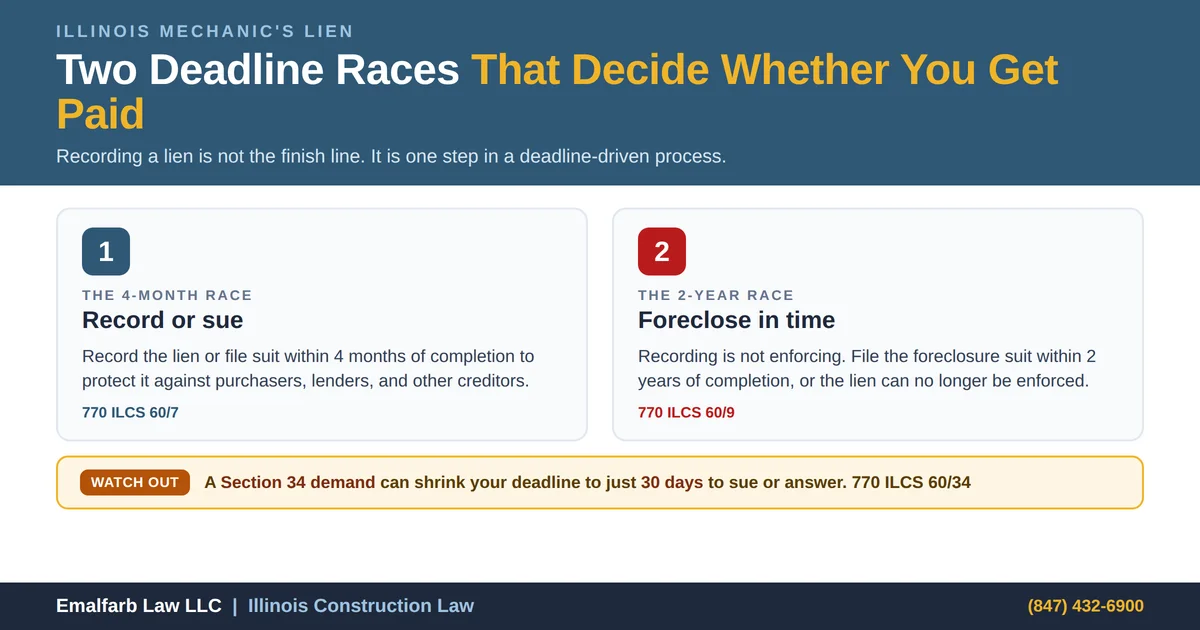
If the supplier contracted directly with the owner, it is a contractor. To preserve enforcement against other creditors, encumbrancers, and purchasers, a contractor must record a compliant claim for lien or commence an enforcement action within four months after the applicable completion or qualifying additional-furnishing date. 770 ILCS 60/7(a). Recording is the usual recommendation. If it contracted with a general contractor or another party below the owner, it is a subcontractor, and under 770 ILCS 60/24(a) it must also serve written notice within 90 days on the statutory owner recipient and the lending agency, if known, using an authorized service method. Section 24 also contains a sworn-statement exception. In either case, suit to enforce the lien must be filed within two years under 770 ILCS 60/9, which 770 ILCS 60/28 incorporates for subcontractors.
Here is the deadline math. Assume the supplier last furnished labor or material on June 30, 2026. The 90-day notice is due September 28, 2026. The four-month deadline to record or sue is October 30, 2026. The two-year enforcement deadline is June 30, 2028. Our full Illinois mechanic lien deadlines guide explains how to fix the last date of furnishing.
Remedy Two: Getting the Material Back
Supplier Owed Money on an Illinois Project?
Send us the contract, the delivery tickets, an inventory of what is installed and what is stored, and the last date you furnished labor or material. We will calendar the lien deadlines, tell you whether the material can be recovered, and identify the remedies that put pressure on the owner. No charge for the initial assessment.
All inquiries answered within 1 business day.
Delivered equipment that has not been installed is generally still personal property. It sits in crates, it carries serial numbers, and it can be moved. That opens remedies under the Mechanics Lien Act, the Uniform Commercial Code, and the Illinois replevin statute that do not exist for material already built into the structure.
Section 4: removing unincorporated material
Section 4 of the Illinois Mechanics Lien Act, 770 ILCS 60/4, addresses an owner's failure to pay or otherwise perform the contract, including discontinuance or abandonment of the work after the owner fails to comply for ten days. In the circumstances described in that section, persons furnishing material that has not been incorporated into the improvement may elect to take possession of and remove it. The right is conditional, not an unrestricted license to enter the property. Where a receiver controls the premises, relief should be requested through the receivership court. For a supplier with crated equipment on site, Section 4 belongs on the list alongside the contract and the Uniform Commercial Code.
A security interest in the equipment
Many suppliers believe that a contract clause saying title stays with the seller until payment lets them retrieve the goods. Under 810 ILCS 5/2-401(1), a seller's retention of title after shipment or delivery is limited in effect to a reservation of a security interest, so the clause is enforced through Article 9. If the contract creates a security interest in the equipment and the customer defaults, 810 ILCS 5/9-609 allows the secured party to take possession of the collateral without judicial process if it proceeds without a breach of the peace, or through the courts if it cannot. Unpaid status alone does not prove an enforceable security interest or a superior right to possession. A security interest that is not perfected by filing a UCC financing statement may lose to the owner's lender, to other creditors, or to a bankruptcy trustee. And once a receiver is in possession of the building, self-help is off the table. The request goes to the court that appointed the receiver.
Reclamation from an insolvent buyer
Even without a security interest, 810 ILCS 5/2-702(2) allows a seller who discovers that the buyer received goods on credit while insolvent to reclaim them on demand made within ten days after receipt. The ten-day limit does not apply if the buyer misrepresented its solvency to the seller in writing within three months before delivery. Under Section 2-702(3), the right is subject to the rights of a good faith purchaser, and a successful reclamation excludes all other remedies with respect to those goods. A supplier that sees a customer stop paying shortly after a delivery should send a written reclamation demand immediately.
Replevin
Replevin is the court proceeding for recovering specific property that is wrongfully detained. Under 735 ILCS 5/19-101, the owner of the goods or the person entitled to their possession may bring the action. Under 735 ILCS 5/19-107, the court enters an order for replevin after notice and a hearing if the plaintiff establishes a prima facie superior right to possession and shows that it will probably prevail on the underlying claim. The plaintiff must post a bond, generally in double the value of the property, under 735 ILCS 5/19-112. Replevin works only for identifiable goods, which is why serial numbers, packing lists, and photographs of stored equipment matter.
Once the Equipment Is Installed
When elevator machines, controllers, and rails are bolted into the hoistway and wired into the building, they are ordinarily treated as fixtures, and the owner and its lender will claim them as part of the real estate. Under 810 ILCS 5/9-334(d), a purchase money security interest in goods that become fixtures can take priority over an earlier recorded real estate interest if the debtor has an interest of record in, or is in possession of, the real property and the supplier makes a fixture filing before the goods become fixtures or within 20 days afterward. That rule is subject to the construction mortgage exception in Section 9-334(h). A supplier whose interest has priority over all owners and encumbrancers of the real property may remove the fixtures after default under 810 ILCS 5/9-604(c), but Section 9-604(d) requires it to reimburse the owner or encumbrancer for the cost of repairing any physical injury the removal causes. In practice, removing installed elevator equipment from an occupied tower is rarely workable, so for installed work the mechanic's lien is the working remedy.
Using the Remedies Together
The remedies are not mutually exclusive, but they cannot be used to collect twice for the same goods. The lien must reflect the amount properly due after applicable credits. Any recovery, disposition, or acceptance of equipment must be accounted for under the applicable contract and law, and the lien balance must reflect the resulting credits. Taking possession of collateral is not necessarily the same as accepting it in satisfaction of the debt; under 810 ILCS 5/9-615, disposition proceeds, expenses, and any deficiency all affect the balance. An unsupported or knowingly inflated balance can generate defenses and additional claims, although Section 7 preserves a lien for its proper amount despite an error or overcharge unless fraudulent intent is shown. Section 35, 770 ILCS 60/35, separately addresses failure to release a lien when its statutory conditions are satisfied.
The strongest position usually layers them: record the lien on time, recover what can still be moved if the contract and facts support it, and when the owner is letting the property deteriorate or diverting its income, consider asking the court to protect the property through a receiver. Appointment is discretionary and requires evidence supporting this extraordinary remedy. An unpaid invoice alone is insufficient. The court considers the applicant's interest in the property and the demonstrated risk to the property or its income. W.E. Erickson Construction, Inc. v. Congress-Kenilworth Corp., 112 Ill. App. 3d 847 (1st Dist. 1983). Section 2-415 of the Code of Civil Procedure, 735 ILCS 5/2-415, then governs the applicant's bond and related procedure. A receiver does not pay the supplier by itself, but it preserves the asset the lien depends on and replaces an owner in default with a court-supervised party.
What Illinois Suppliers Should Do Now
- Put a security interest in the contract. Include a clause granting a security interest in the equipment until it is paid for, along with the right to enter the site and retrieve material that has been delivered but not installed.
- Know your Section 4 rights. If the owner defaults and the work is discontinued or abandoned, 770 ILCS 60/4 may allow removal of material not yet incorporated.
- File the financing statement. File a UCC financing statement in the customer's state of organization, and calendar a fixture filing in the county where the real estate sits if the equipment will become a fixture.
- Document every delivery. Keep signed delivery tickets showing the project address, and photograph stored material with its serial numbers visible.
- Track installed and stored separately. Maintain a running inventory of what has been installed and what remains in storage, because the remedies differ for each.
- Pull title early. Identify the fee owner, any ground lessor, and every lender before the lien is recorded.
- Calendar the lien deadlines from the last date of furnishing. Serve the Section 24 notice within 90 days if you are not in contract with the owner, and record the claim (or sue) within four months.
- Watch the property, not only the invoice. Unpaid property managers, lapsed insurance, and diverted rents are signs that the security behind the lien is at risk, and that a receivership motion may be worth considering.
Conclusion
Illinois mechanic lien law protects suppliers for delivered material as well as installed work, but the lien is only the starting point. Section 4 of the Act, a security interest, a timely reclamation demand, or a replevin action can put uninstalled material back in the supplier's hands, and a receiver can protect the building that secures the lien when the owner will not. At 33 West Monroe, that approach took an unmanaged office tower out of the owner's control and put it under a court-appointed receiver while Nouveau's lien foreclosure proceeds. If you have furnished labor or material to an Illinois project and have not been paid, contact Emalfarb Law LLC at (847) 208-6513 or [email protected] before the deadlines run. See also our Illinois mechanic lien foreclosure page.