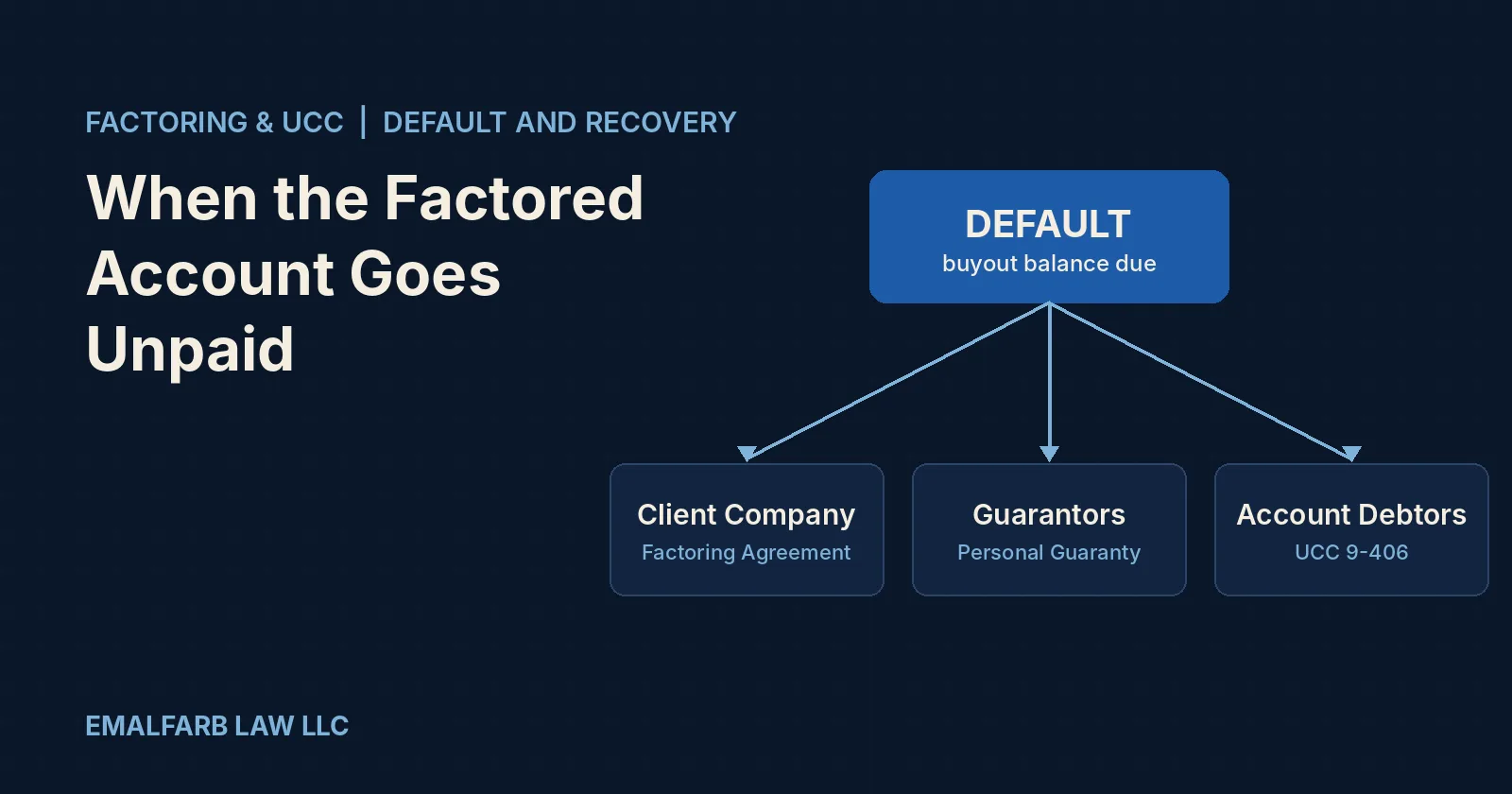
October 12, 2026 · Factoring & UCC
Signing Up a Factoring Client: The Four Documents
Many of the rights and records a bank or factor needs when a factoring client fails are established at onboarding. Here are four core document categories to have in place before the first funding: the factoring and security agreement with its purchase records, personal guaranties, a UCC-1 filed in the correct state, and a notice of assignment with evidence of receipt.
Signing up a new factoring client is a credit decision, but it is also a legal one. Many critical recovery rights, and much of the supporting evidence, are established in the documents and records assembled before the first funding. When we review a default file for a factor, the onboarding file is one of the first things we examine, because it often shapes what can be recovered.
This article walks through four core document categories for an ordinary commercial factoring program, in the order they are typically completed, and explains what each one does when a seller stops performing. They are core categories, not a complete universal package; particular programs may need more. For a fuller treatment of each topic, see the firm's Factoring & UCC practice.
Step 1: The Factoring and Security Agreement, and the Purchase Records
The factoring and security agreement is the contract the relationship rests on. It should identify and transfer the purchased accounts, allocate credit and performance risk, and define the seller's obligations, such as repurchase of accounts that remain unpaid and remittance of collections received. Where the program calls for additional security, it should include an enforceable collateral grant securing those obligations.
A sale of accounts is generally governed by Article 9 of the Uniform Commercial Code under UCC § 9-109(a)(3), adopted in Illinois at 810 ILCS 5/9-109(a)(3), subject to the exclusions in § 9-109(c) and (d). For Article 9 purposes, the purchaser is a secured party and the seller is a debtor. Those classifications do not, by themselves, make a purchase a loan. For the factor's interest to attach, § 9-203(b) requires value, the seller's rights in the accounts, and a qualifying agreement.
The agreement should be specific about the following points:
- The purchase price, advance rate, reserve, and fees, with a clear, auditable payoff calculation
- The allocation of nonpayment risk, including any repurchase or reimbursement obligations; in recourse programs the seller retains specified nonpayment risks, and in non-recourse programs the factor assumes specified credit risks while the seller commonly remains responsible for disputes and warranty breaches
- Warranties that each invoice reflects completed and accepted work or delivered goods, is owed without undisclosed dispute or offset, and has not been sold or pledged to anyone else
- Covenants that collections received on purchased accounts will be remitted as the agreement requires and that remittance instructions will not be changed
- Events of default that track those warranties and covenants, and an express provision for reasonable attorneys' fees and enforcement expenses
Equally important are the purchase records: the offers, acceptances, schedules, and funding records that show which invoices were actually bought. The most important distinction in a later dispute is between a master agreement that authorizes purchases and evidence that a particular account was purchased. The agreement should be accompanied by organizational documents, a resolution or consent, and evidence that the signer has authority to sell the accounts.
Step 2: Personal Guaranties
A seller's principals influence much of what determines whether a purchased invoice is collectible: what is invoiced, how collections are handled, and what account debtors are told. A personal guaranty can make a principal answerable within its terms.
Factoring programs typically use a guaranty of payment and performance, a validity guaranty that generally addresses specified representations or conduct, or both. The Illinois Frauds Act, 740 ILCS 80/1, requires a promise to answer for the debt of another to be in a writing signed by the party to be charged or a lawfully authorized signer. Obtain a written guaranty signed in the intended individual capacity before relying on it; a separate guaranty with a clear individual signature block reduces disputes over whether the principal signed personally or only for the company.
Confirm the consideration supporting each guaranty. A guaranty signed with the agreement before the first purchase is ordinarily supported by that transaction; one obtained after funding should document new consideration. The guaranty should state the obligations guaranteed, whether it is continuing, and that it is a guaranty of payment rather than of collection, and it should include waivers drafted to be enforceable under the governing law and a notice address for the notices and demands to guarantors.
Step 3: The UCC-1 Financing Statement
A factor ordinarily perfects its interest in purchased commercial accounts by filing an effective financing statement under UCC § 9-310. Perfection is what protects the factor against the seller's other creditors, later purchasers of the same accounts, and a bankruptcy trustee. Section 9-318(b) makes the point: while the buyer's interest in sold accounts is unperfected, the seller is deemed to have rights in them as against creditors and purchasers for value. Exceptions and different perfection methods apply to certain transactions and collateral types.
Two details often decide whether the filing works. First, for ordinary accounts owned by a state-organized registered organization, the filing generally belongs in the seller's state of organization under §§ 9-301(1) and 9-307(e), not where it does business. Second, the name must match the most recently filed or issued public organic record that states, amends, or restates the debtor's name, as § 9-503(a)(1) provides. A debtor-name error can make the filing seriously misleading and ineffective under § 9-506; a statutory search-logic safe harbor may apply, but a factor should not rely on it when preparing the filing.
Before the first funding, run an entity search to confirm the state of organization and exact name, and a UCC search to identify prior filings by other funders or lenders. Where a prior lender claims accounts, review its actual collateral description, secured obligations, proceeds claims, consent, and the proposed priority arrangement. A financing statement generally lapses after five years under § 9-515 unless continued within the six months before lapse, and filing-office acceptance does not by itself confirm that the filing is effective. A UCC-1 perfects the factor's interest; it does not prove which invoices were purchased.
Step 4: The Notice of Assignment and Evidence of Receipt
The notice of assignment tells each account debtor that the seller's accounts have been assigned to the factor and that payment must be made to the factor. Under UCC § 9-406(a), adopted in Illinois at 810 ILCS 5/9-406(a), after receipt of the notification, the account debtor may discharge its obligation by paying the assignee and may not discharge it by paying the assignor, subject to the statute's qualifications. The current Illinois text uses the word "signed," following the 2025 amendments, and a qualifying electronic signature can satisfy that requirement.
An effective notice:
- Is signed by the seller or the factor
- States that the amount due or to become due has been assigned
- Directs payment to the factor, with exact remittance instructions
- Reasonably identifies the rights actually assigned, which may be specified invoices or an identified class of present and future accounts, depending on the purchase structure
Deliver the notice through a channel reasonably calculated to reach the account debtor's responsible personnel, and preserve evidence of receipt. Asking the account debtor to sign and return an acknowledgment is sound practice: a signed acknowledgment provides valuable evidence of receipt and of the payment instructions communicated. It does not automatically waive the account debtor's defenses under § 9-404. Any invoice verification, estoppel, or agreement not to assert defenses is a different document and should be separately evaluated for authority, scope, consideration where required, and enforceability.
Account debtors sometimes point to an anti-assignment clause in their own contract. For ordinary commercial accounts, § 9-406(d) generally makes contractual restrictions on assignment of the payment right ineffective, although exceptions, federal law, and special receivable rules must still be checked. The account debtor may also request reasonable proof of the assignment under § 9-406(c), and the factor should answer promptly with the assignment provisions and the invoice-level purchase records.
After Onboarding: Ongoing Monitoring
Onboarding is not the end of the legal work. The middle of the relationship is where many problems begin, and a program benefits from periodic attention to the following:
- Continuation dates and confirmation that each filing remains effective
- Name, organizational, merger, and jurisdiction changes affecting the seller
- Periodic entity and lien searches for new competing filings
- Concentration, aging, dilution, and reserve review
- New disputes, credits, returns, and backcharges reported by account debtors
- Duplicate-financing checks and invoice verification
- Changed bank instructions, verified through a previously established telephone number or other trusted channel
Keep the File Together
The four categories work as a system. The agreement and purchase records define what was bought and what the seller owes. The guaranties may make principals answerable within their terms. The UCC-1 protects the factor's interest against competing claims. The notice of assignment, with evidence of receipt, means a later payment to the seller generally does not discharge the assigned obligation. If one is missing or defective, the factor's position depends more heavily on the others.
We recommend that each seller file contain, in one place, the executed agreement and amendments, the purchase and funding records, the authority documents, each signed guaranty, the filed UCC-1 and the pre-filing searches, and each notice of assignment with its transmittal and evidence of receipt. If the relationship later fails, that file supports the demand letters. The next article in this series explains what happens when a factored account goes unpaid.
If you are onboarding a new seller, or reviewing an existing program before increasing a facility, contact Emalfarb Law LLC. We will review the documents and filings and identify gaps before they matter. This article is general information, not legal advice for any particular transaction.