May 8, 2026 · Mechanic Liens
Do You Have to Wait 10 Days After a 90-Day Notice to File an Illinois Mechanic Lien?
The 10-day wait between the 90-day notice and recording is a myth. Three Illinois Appellate Districts have held that 770 ILCS 60/28's 10-day rule applies to filing suit, not to recording the lien.
Every Illinois subcontractor has heard the same advice from a project manager, a credit manager, or an out-of-state lawyer: serve your 90-day Section 24 notice, then wait 10 days before recording your mechanic lien. The advice is wrong, and three Illinois Appellate Districts have said so. The Fourth District in A.Y. McDonald Mfg. Co. v. State Farm Mut. Auto. Ins. Co., 225 Ill. App. 3d 851 (1992), the First District in Cordeck Sales, Inc. v. Construction Systems, Inc., 382 Ill. App. 3d 334 (2008), and most recently the Second District in Matteo Construction Co. v. Teckler BLVD Development Site, LLC, 2020 IL App (2d) 190766, have all held that 770 ILCS 60/28 does not require the §24 notice to predate recording of the §7 claim for lien by 10 days. The 10-day language is a ripening provision for the §9 foreclosure suit, not a waiting period that delays recording.
For Illinois subcontractors, sub-subcontractors, and material suppliers, the distinction matters most when the 4-month §7 recording deadline is closing. A claimant who is told, incorrectly, that he or she must wait 10 days after serving the §24 notice before recording the lien may run out the §7 window and forfeit the claim entirely. The 4-month §7 window is strict. The 10-day language in §28 is not.
What 770 ILCS 60/28 Actually Says
Section 28 of the Illinois Mechanics Lien Act, 770 ILCS 60/28, reads in pertinent part:
If any money due to laborers, materialmen, or sub-contractors be not paid within 10 days after his notice is served as provided by sections 5, 24, and 25, then such person may file a claim for lien or file a complaint to enforce within the same limits as to time and in such other manner as hereinbefore provided for the contractor in section 7 and sections 9 to 20 inclusive, of this Act.
Read carefully, three things are clear. First, the operative verb is "may", permissive, not mandatory. Second, the connector between file a claim for lien and file a complaint to enforce is "or", these are two independent options the statute makes available once the 10-day window closes without payment. Third, the cross-references are to §7 (the 4-month recording window) and §§9-20 (the foreclosure framework), the Section places the subcontractor's remedy on the same statutory rails that govern the prime contractor.
What §28 does not contain is a sentence saying "the claim for lien shall not be recorded until 10 days have elapsed." That language does not appear anywhere in the Mechanics Lien Act. Read alongside 770 ILCS 60/7, which authorizes a contractor to file his or her claim for lien at any time after the contract is made, the structure of the Act is consistent: recording is permitted as soon as a lienable claim exists, and the 10-day language in §28 governs the maturity of the suit on the lien, not the recording of the claim.
What the Illinois Cases Actually Hold
Three Illinois Appellate decisions, spanning three different Districts and nearly thirty years of practice, settle the question.
Matteo Construction Co. v. Teckler BLVD Development Site, LLC, 2020 IL App (2d) 190766
Matteo is the most recent and most direct authority. The trial court dismissed a subcontractor's lien foreclosure complaint on the theory that the subcontractor had not waited 10 days after serving its §24 notice before recording the §7 claim for lien. The Second District reversed. The court held that the trial court had misread §28. The subcontractor in Matteo had served the §24 notice, recorded the lien two days later, and then waited more than 10 days after the notice before filing the §9 foreclosure complaint. That sequence, the Second District held, satisfied the statute.
The Second District's reasoning relied heavily on §7. Section 7 expressly authorizes a claim for lien to be filed "at any time after the claimant's contract is made." Reading §28 to prohibit recording within 10 days of notice would, the court explained, undercut the §7 grant of authority. The court declined to imply a waiting period that the legislature did not write into the text. The 10-day period in §28 was satisfied because the claimant waited more than 10 days after notice before filing suit to enforce the lien, which is what §28 actually requires.
Matteo is the strongest authority practitioners can cite for the proposition that the 10-day period is not a mandatory waiting period before recording. It is recent, on point, and directly addresses the trial-level argument that defendants still occasionally raise.
A.Y. McDonald Mfg. Co. v. State Farm Mut. Auto. Ins. Co., 225 Ill. App. 3d 851 (1992)
A.Y. McDonald is the case that established the rule. There, the subcontractor recorded its lien and served notice on the owner on the same day. The owner argued that the lien was invalid because the §24 notice had not preceded recording by 10 days. The Fourth District rejected the argument. The court held that §28 "does not require that section 24 notice predate recording by 10 days" but rather permits a claim for lien or an enforcement complaint after 10 days if payment has not been made. Because the subcontractor in A.Y. McDonald filed its enforcement complaint more than 10 days after notice, it complied with the Act.
A.Y. McDonald is the foundational authority. It is cited by every subsequent Illinois case that has addressed the §28 timing question, and it is the case that the IICLE Mechanics Liens treatise points to when describing the framework.
Cordeck Sales, Inc. v. Construction Systems, Inc., 382 Ill. App. 3d 334 (2008)
Cordeck Sales is the First District's adoption of the A.Y. McDonald rule. A subcontractor recorded its claim and served notice on the same date, then waited more than 10 days before filing suit. The owner argued the lien had not been properly perfected because of the §28 timing requirement. The First District rejected the challenge, holding that recording the lien and sending notice on the same date did not invalidate the claim where the subcontractor waited more than 10 days before filing suit. The court framed the 10-day requirement as relating to enforcement timing, not as a strict pre-recording waiting period.
Cordeck Sales is also the leading Illinois authority on relation-back doctrine and on the strict-compliance framework that governs Illinois mechanic liens generally. The §28 holding is one piece of a much longer opinion, but it is squarely on point and binding in the First District.
Lesniak v. Wesley's Flooring, Inc., 2013 IL App (1st) 122146
Lesniak is consistent with A.Y. McDonald and Cordeck Sales, it recites the same framework, but it is a Rule 23 order and is generally not citable as precedent except in the limited circumstances Rule 23 allows. We mention it here for background and would not rely on it as primary authority in a §28 dispute.
When the 10-Day Clock Actually Matters
The Illinois cases all converge on the same rule: the 10-day period in §28 governs the timing of the §9 foreclosure suit, not the recording of the §7 claim for lien. A defendant served with a §9 complaint can argue, with real statutory support, that the suit was filed prematurely if the complaint was filed before 10 days had elapsed after the §24 notice. Matteo and A.Y. McDonald both turned on the fact that the claimant waited more than 10 days after notice before filing suit. That sequencing is what §28 actually demands.
The argument has nothing to do with recording. The §7 claim for lien is recorded with the county recorder of deeds; the §9 complaint is filed with the circuit court. They are separate statutory acts with separate statutory windows, and §28 governs only the second one. A subcontractor who serves the §24 notice on Monday, records the §7 claim on Tuesday, and then waits 60 days before filing a §9 complaint has done everything correctly under the Act, and Matteo says so directly.
Where the 10-Day Waiting Myth Came From
The myth is intuitive. If §28 says a claimant may record after 10 days, the natural assumption is that he or she may not record before 10 days. The negative pregnant reads itself into the statute. Generations of form books, online guides, and out-of-state practitioners have repeated the assumption until it hardened into folk wisdom on Illinois projects. The Illinois Appellate Court has rejected that reading three times across three Districts, but the myth persists in the field.
Levelset's reporting, Illinois Court Says Claimants Can File Lien Within 10 Days of Notice, was useful precisely because it dispelled the carryover for a non-lawyer audience. The IICLE Mechanics Liens treatise frames the same point in technical terms: the 10-day language in §28 is a ripening provision that controls the timing of the foreclosure suit, not an independent procedural prerequisite to recording. The standard practitioner advice that has emerged from the Illinois bar, and the rule that Matteo, A.Y. McDonald, and Cordeck Sales support, is to serve the §24 notice and record the §7 claim on whatever timeline best protects the client, including same-day service and recording when the §7 window is closing.
Racing the 4-Month §7 Deadline?
If your last day of furnishing was more than 90 days ago and the 4-month §7 recording window is closing, do not delay recording the lien because of the old 10-day myth. Send us your Section 24 notice draft, your contract chain, and your last invoice, we will serve and record the same day if necessary, and tell you up front whether the claim is enforceable. No charge for the assessment.
All inquiries answered within 1 business day.
The Three Deadlines That Actually Govern Subcontractor Lien Rights
The 10-day language in §28 is not a deadline. The deadlines that actually govern an Illinois subcontractor's lien rights are three, and missing any of them is fatal:
1. The §24 notice deadline, 90 days (or 60 on owner-occupied residential). Under 770 ILCS 60/24, every claimant who does not have a direct contract with the property owner must serve a written notice on the owner, the owner's lender of record, and certain other parties within 90 calendar days of the claimant's last day of furnishing labor or materials. On owner-occupied single-family residential projects, §5(b)(ii) shortens the window to 60 days. Miss the §24 deadline and the lien is permanently forfeited as against third parties, there is no cure.
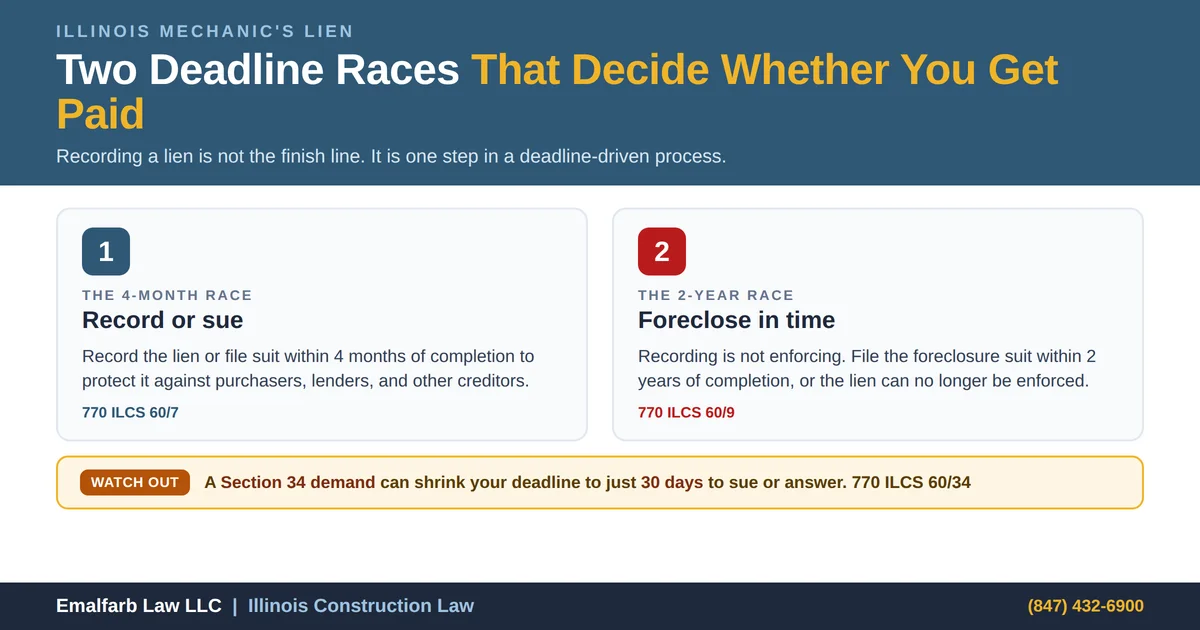
2. The §7 recording deadline, 4 months. Under 770 ILCS 60/7, the claim for lien must be recorded with the recorder of deeds in the county where the property is located within 4 months of the same last day of furnishing for the lien to bind third parties such as subsequent purchasers and lenders. Recording within 4 months but after 2 years still binds the original owner, but not third parties, and is rarely worth the effort. Our 4-month deadline page walks through the recording window in detail.
3. The §9 enforcement deadline, 2 years. Under 770 ILCS 60/9, the complaint to foreclose the lien must be filed within 2 years of the same last day of furnishing. The window is jurisdictional and the lien is extinguished if the complaint is not filed in time. See our mechanic lien foreclosure page for the §9 framework and the related 30-day demand provision under §34.
Three windows. All measured from the same last day of furnishing. None of them is the 10-day window in §28. A subcontractor who internalizes these three deadlines and ignores the 10-day myth will perfect lien rights correctly every time. A subcontractor who waits 10 days after the §24 notice on a project where the §7 window closes 9 days from now has just forfeited the lien.
A Worked Example: The Race Against §7
Consider a Cook County subcontractor whose last day of furnishing was January 10. The 4-month §7 recording window closes on May 10. The 90-day §24 notice window closes on April 10. The subcontractor is unpaid as of April 5. He calls a lawyer.
Under the 10-day myth, the subcontractor would serve the §24 notice on April 5, wait 10 days until April 15, and then record the §7 claim. That is fine, both deadlines are satisfied. But change the facts slightly: the subcontractor is unpaid as of May 3, just 7 days before the §7 window closes. Under the myth, the subcontractor would serve the §24 notice on May 3, wait 10 days until May 13, and then record. May 13 is 3 days after the §7 window closed. The lien is gone.
Under the actual statute, the subcontractor serves the §24 notice on May 3 and records the §7 claim on the same day, or on May 4. Both windows are satisfied. The subcontractor's lien is enforceable. The §28 10-day language has no application, it would only matter later, if the subcontractor filed a §9 foreclosure suit before May 13. There is no reason to file the suit that quickly, and the subcontractor's counsel won't.
This is not a hypothetical. It happens on Illinois projects with some regularity, particularly when the subcontractor is the last party to be informed that the general contractor is not going to pay. The 10-day myth has cost real claimants real lien rights. It does not have to.
Practical Guidance for Illinois Subcontractors and Suppliers
Calendar three deadlines, not four. From the moment work begins, calendar the §24 deadline (90 days, or 60 on owner-occupied residential), the §7 deadline (4 months), and the §9 deadline (2 years), all measured from the projected last day of furnishing. Update each as the project evolves. Do not calendar a 10-day waiting period after the §24 notice, it does not exist.
Serve the §24 notice early, but do not let it gate the recording. Best practice is to serve the §24 notice as soon as a payment problem becomes apparent. Early service gives the owner an opportunity to pressure the general contractor or pay directly under §27. But if early service is not possible, if the subcontractor only learns of the non-payment near the end of the §7 window, serve and record on the same day if necessary. The Mechanics Lien Act permits it.
Use the new §24 delivery options under HB 4660. Public Act 103-0827, effective January 1, 2025, allows §24 notices to be served by FedEx, UPS, DHL, or any other nationally recognized carrier with tracking, and removed the restricted-delivery requirement on certified mail. For a §24 notice served late in the 90-day window, FedEx or UPS overnight delivery with morning confirmation gives the claimant the same-day proof of service needed to record the §7 claim immediately afterward. See our HB 4660 article for the new delivery rules in detail.
Document the §24 service before recording the §7 claim. Even when service and recording happen on the same day, the §24 notice should be served first and the proof of service, tracking confirmation, return receipt, signed acknowledgment, should be in the file before the §7 claim is recorded. The order matters for the record even if no statutory waiting period separates them.
Calculate the §7 window from the right last day of furnishing. This is where most §7 mistakes actually originate, not the 10-day myth, but a wrong reading of the last day of furnishing. Punch-list work, warranty work, and corrective work generally do not extend the §7 window. Contracted extra work does. See our companion article on the last day of furnishing and on punch-list versus extra work for the distinctions.
Use the deadline calculator. Our Illinois mechanic lien deadline calculator takes the last day of furnishing and returns all three statutory windows, §24, §7, and §9, in one screen. It does not display a 10-day window after the §24 notice, because the statute does not impose one.
Why Illinois Differs from Many Other States
Practitioners who learned mechanic lien law in other jurisdictions often import the 10-day myth from states that do impose true pre-filing waiting periods. Texas, California, and several other states have notice-of-intent regimes under which a claimant must serve the owner with a written intent-to-lien notice and then wait a defined number of days, often 10, 20, or 30, before the lien can be recorded. The waiting period gives the owner an opportunity to cure the default before the lien attaches.
Illinois does not work that way. The §24 notice is a notice of an existing lien claim, not a notice of intent to file one in the future. The §7 recording authority exists from the moment the contract is made. The 10-day language in §28 ripens the right to sue on the lien, the §9 foreclosure complaint, but does not gate the recording of the lien itself. The practical effect is that Illinois subcontractors have more procedural flexibility than counterparts in some neighboring states, and less reason to wait between service and recording.
How This Fits with the Rest of the Illinois Lien Framework
The 10-day clarification is part of a broader pattern in Illinois lien law: the deadlines that bite are the §24 90-day window, the §7 4-month window, and the §9 2-year window, all measured from the last day of furnishing. Other timing rules, the 10-day language in §28, the 30-day demand under §34, the 30-day owner response under §27, exist, but they govern remedies and procedure within the broader framework rather than creating independent forfeitures.
The companion deadline articles in our library walk through the related timing questions in depth: the 2-year §9 enforcement deadline, privity-driven classification of contractors versus subcontractors, the last day of furnishing analysis, and the common defects that void Illinois lien claims even when the deadlines are met. For the full statutory framework, see our Illinois mechanic lien deadlines hub and the subcontractor lien rights overview.
The Bottom Line
Illinois case law does not support an absolute rule that subcontractors must wait 10 days after sending a 90-day §24 notice before recording the mechanic lien. The Fourth District in A.Y. McDonald Mfg. (1992), the First District in Cordeck Sales (2008), and the Second District in Matteo Construction (2020) have all rejected that reading of 770 ILCS 60/28. The safer, more precise rule is the one those courts articulated: §28 requires the claimant to wait more than 10 days after notice before filing suit to enforce the lien, but the same statute does not bar recording the lien before the 10-day period expires. The Mechanics Lien Act expressly authorizes a contractor to file the claim for lien at any time after the contract is made under §7, and the appellate courts have refused to imply a pre-recording waiting period that would undercut that grant of authority.
What matters is the §24 90-day window, the §7 4-month window, and the §9 2-year window, all measured from the last day of furnishing. Calendar those three. Serve the §24 notice as early as possible, but do not let the 10-day myth keep you from recording on the same day if the §7 window is closing. If you are unsure whether your last day of furnishing has triggered the §7 clock, or whether your §24 notice was served correctly under the post-HB 4660 rules, contact our office at (847) 432-6900 for a no-charge assessment of your claim.