October 30, 2026 · Mechanic Liens
Illinois Mechanic's Lien Removal by Bond
Recording a surety bond with the county recorder does not, by itself, remove an Illinois mechanic's lien from the property. Section 38.1 of the Mechanics Lien Act requires a verified petition, statutory notice, and a court order substituting an eligible bond, followed by recording the order and the approved bond. Here are the steps, the recent appellate decisions, and the traps owners and general contractors should avoid.

A mechanic's lien can stall an Illinois property sale, a refinancing, or a construction draw. Owners and general contractors often ask whether they can remove the lien by purchasing a surety bond and recording it with the county recorder.
Recording a bond alone does not substitute the bond for the property under Illinois law. Section 38.1 of the Illinois Mechanics Lien Act provides a court-supervised process. The court's substitution order is the critical step, followed by recording the order and the approved bond. 770 ILCS 60/38.1(c) through (g), (l). For an owner or general contractor trying to protect a closing or financing transaction, getting that process right matters as much as obtaining the bond itself.
The Fact Pattern: A Recorded Bond, but No Court Order
Consider an illustrative Illinois roofing payment dispute. A subcontractor records a mechanic's lien against the project property. A party seeking to protect the owner obtains a bond and sends it to the recorder's office before obtaining a court substitution order.
The recording clerk questions the absence of a case number. Counsel explains that recording the bond now should avoid later title-related recordings. The recorder accepts the document.
Has the lien been removed from the property? Not by that recording alone. Acceptance for recording is not judicial approval. Section 38.1 requires a verified court petition, statutory notice, a determination that the bond is eligible, and an order substituting the bond for the property. It then requires recording the order together with an executed copy of the approved bond. 770 ILCS 60/38.1(c) through (g).
This illustration omits identifying details and does not report the outcome of any particular client matter.
What Does It Mean to Bond Off an Illinois Mechanic's Lien?
Bonding off a lien replaces the property securing the lien claim with an eligible surety bond through a court order. It does not establish that the claimant is wrong, erase the recorded lien from the historical land records, or pay the disputed balance. The process separates two issues:
- Protecting the property: obtaining an order discharging the property as security for the affected lien claim.
- Resolving the dispute: determining whether the claimant has an enforceable claim and what amount, if any, is recoverable from the bond principal and surety.
The principal and surety may assert the defenses the statute permits. Separate claims that do not arise under the Mechanics Lien Act, such as a breach of contract claim against the party that hired the claimant, are not automatically eliminated. 770 ILCS 60/38.1(h) through (j), (l).
Who Can Seek Substitution?
An eligible applicant can include an owner, another person with an interest in the property, or a person potentially liable for payment of the lien claim, including a contractor or subcontractor. A general contractor may therefore pursue substitution to protect the owner's property while the underlying payment dispute with its subcontractor continues. Eligibility should be confirmed for the particular applicant and project. 770 ILCS 60/38.1(a)(1).
Steps to Follow When Bonding Off a Lien in Illinois
1. Review the Lien, Lawsuit, and Transaction Deadline
Start with the recorded lien, notices, contracts, payment records, title commitment, and any pending pleadings. Identify each lien affecting the property and determine whether substitution, settlement, or a challenge to lien validity best serves the owner's objectives.
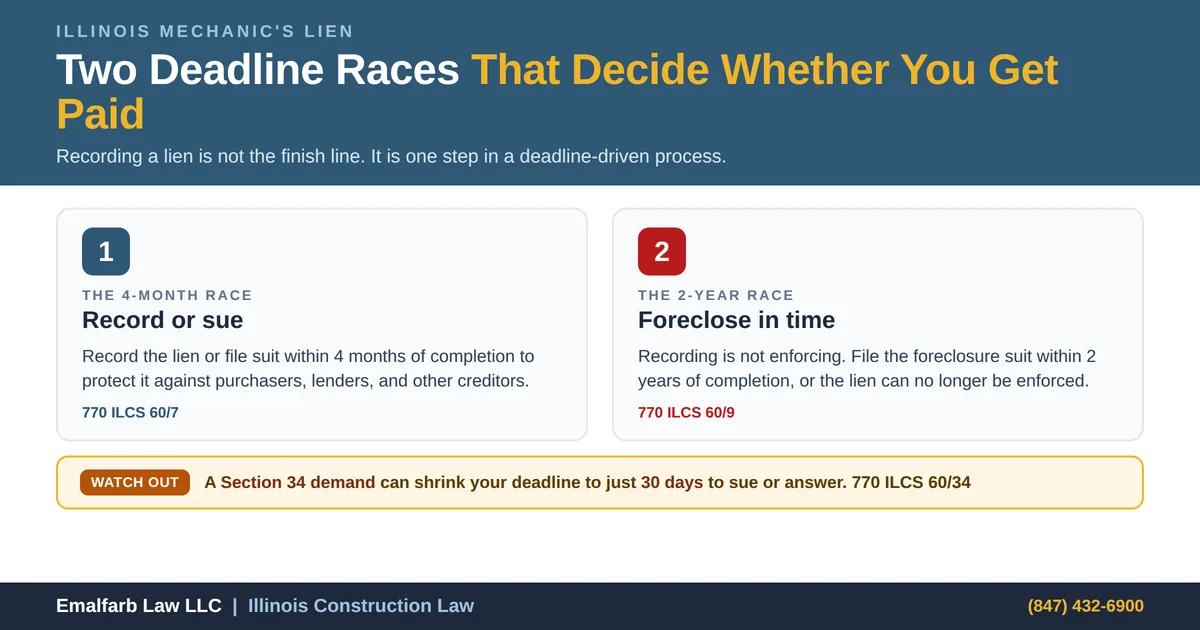
Do not assume that defeating the lien is the fastest way to protect title. A substitution proceeding addresses the security for the claim without requiring the court first to decide the entire payment dispute. If no suit has been filed, a Section 34 demand to sue is a separate tool that can force the claimant to file within 30 days or lose the lien, and it may be used alongside a substitution strategy.
If a foreclosure action is already pending, section 38.1(c) imposes a five-month filing limit tied to the claimant's complaint or counterclaim. Calendar conservatively and file before the statutory cutoff. 770 ILCS 60/38.1(c).
2. Obtain an Eligible Surety Bond
Not every bond qualifies. Section 38.1(a)(2) requires, among other things:
- A bond amount equal to 175% of the lien claim, with the statutory definition of lien claim excluding interest and attorney's fees.
- Required language submitting the principal and surety to the jurisdiction of the circuit court where the property is located.
- Required language addressing liability for a final, nonappealable judgment, including interest and attorney's fees, within the bond limit.
- Continued effectiveness for the period required by the statute.
- A surety authorized to execute surety bonds by the Illinois Department of Insurance.
- An A.M. Best financial strength rating of at least A without a rating modifier, a stable or positive outlook, and a financial size category of at least IX.
- Compliance with any applicable circuit-specific approved-surety requirement.
Review the actual executed instrument, not merely a broker's description or bond cover sheet. 770 ILCS 60/38.1(a)(2) and (3).
3. File a Verified Petition in the Proper Circuit Court
The petition belongs in the circuit court of the county where the property is located. A lien claimant does not need to have filed foreclosure first.
The petition must include the required party information, property description, proposed bond, certified surety authorization, replacement undertaking, and other statutory materials. Where no enforcement proceeding is pending, the statute requires the specified copy and recording information for the lien claim. A legal description should be checked against the property records rather than copied without review. 770 ILCS 60/38.1(c).
4. Serve the Petition and Required Notice
The statute requires personal service or certified mail, return receipt requested, on the specified recipients, including counsel of record where applicable. An informal email announcing that a bond has been recorded is not a substitute for this process.
The prescribed notice warns that objections must be filed by the earlier of 30 days after receipt or 33 days after certified mailing. Counsel should reconcile that notice language with the service, motion, and hearing provisions in subsections (e) and (f) before scheduling an uncontested approval request. Do not assume the court can approve substitution immediately after mailing. 770 ILCS 60/38.1(d) through (f).
A Mechanic's Lien Is Holding Up Your Closing or Draw?
Send us the recorded lien, the title commitment, the construction contract, payment records, any lawsuit papers, and the proposed bond. We will identify the substitution deadline, check the bond against section 38.1, and lay out the fastest compliant path to clear the property.
All inquiries answered within 1 business day.
5. Obtain the Substitution Order
Even without an objection, court approval is not automatic upon recording or upon expiration of a deadline. The applicant must obtain an order, and the court must find the proposed bond eligible.
If an objection is filed, the statute provides a hearing procedure and allocates the burdens concerning eligibility. A claimant's objection does not give the claimant an unrestricted veto over a qualifying statutory substitution. 770 ILCS 60/38.1(e) and (f).
6. Record the Order and Executed Approved Bond
After approval, send copies of the order to the required recipients and record both the order and an executed copy of the approved bond in the county or counties where the property is located.
Then coordinate with the title insurer, lender, and closing counsel to confirm what they require to update the title commitment and address the affected exception. A statutory substitution order should not be confused with a guarantee that every other closing condition has been satisfied. 770 ILCS 60/38.1(g). Our Illinois residential closings practice regularly coordinates this step with title companies.
7. Continue Managing the Underlying Dispute
If litigation is pending when the bond is approved, the statute makes the bond principal and surety parties to the proceeding by operation of the approval. Other parties to the lien counts may be dismissed, but counsel should address the pleadings and remaining claims rather than assuming the entire lawsuit disappears. 770 ILCS 60/38.1(h).
Illinois Cases Owners and General Contractors Should Know
Lamar Johnson: An Amended Complaint Does Not Restart the Bonding Deadline
In The Lamar Johnson Collaborative Inc. v. 225 W. Randolph Owner, LLC, the Illinois Appellate Court held that the five-month substitution-petition period runs from the earliest pleading asserting the lien claim. Dismissal of the original complaint with leave to amend, followed by an amended complaint asserting the same lien, did not restart the clock. The court affirmed denial of the untimely petition. 2026 IL App (1st) 250620, ¶¶ 11 to 18.
Practical lesson: Track the first lien-enforcement pleading. Do not wait for an amended complaint, an answer, or resolution of a motion to dismiss before considering substitution. This decision addresses timing, not the legal effect of prematurely recording a bond; the statutory text supplies the court-order requirement.
Englewood Construction: Challenging a Lien Is Not Always a Quick Route to Clear Title
In Englewood Construction v. J.P. McMahon Properties, the Appellate Court reversed summary judgment invalidating a lien where material factual questions remained concerning fraudulent intent. It also reversed summary judgment on the related quiet-title claim, explaining that if the lien ultimately proved valid, it could not constitute an improper cloud supporting that claim. 2025 IL App (3d) 240389, ¶¶ 65 to 81.
Practical lesson: A disputed or allegedly overstated lien is not automatically invalid. When a transaction cannot wait for a merits determination, evaluate statutory bond substitution early. Englewood does not hold that every owner must obtain a bond, and it did not decide the validity of an unapproved recorded bond.
What Are the Common Traps in Illinois Mechanic's Lien Removal?
- Trap: "The recorder accepted the bond, so the lien is gone." Better approach: Obtain the court's substitution order, then record the order and approved bond.
- Trap: "We must wait for the subcontractor to sue." Better approach: Evaluate a stand-alone substitution petition before foreclosure litigation.
- Trap: "The amended complaint gives us another five months." Better approach: Calendar from the first pleading asserting the lien claim, consistent with Lamar Johnson.
- Trap: "Any licensed surety and standard bond form will work." Better approach: Check every eligibility requirement, including ratings, duration, jurisdiction language, and applicable local approval requirements.
- Trap: "An email about the bond is enough notice." Better approach: Follow the statutory service methods and use the required notice.
- Trap: "Bonding off means we no longer owe anything." Better approach: Distinguish removal of the property as security from resolution of the underlying claim.
- Trap: "This bond clears every lien on the project." Better approach: Identify precisely which lien claim and property the petition and order cover, and check for other liens.
These procedural requirements arise under 770 ILCS 60/38.1; the pleading-deadline warning is illustrated by Lamar Johnson, 2026 IL App (1st) 250620.
A Less Obvious Trap: Attorney's Fee Exposure Changes the Economics
Section 38.1 has its own prevailing-party rules. A claimant awarded at least 75% of its lien claim qualifies as a prevailing party; the bond principal qualifies if the claimant receives less than 25%. Between those thresholds, neither qualifies under that definition. The statute addresses adjustments for payments and contains limits on fee awards.
The prevailing-party fee provision is mandatory when its conditions apply. Owners and contractors should evaluate that exposure, along with the surety's premium, collateral requirements, and indemnity terms, before choosing a bond strategy. Bond substitution protects the property as security; it does not make litigation risk disappear. 770 ILCS 60/38.1(a)(5), (i).
How Emalfarb Law LLC Can Help Protect the Owner
A successful lien-removal strategy should address both the owner's title problem and the contractor's payment dispute. Depending on the engagement and any conflicts of interest, an Illinois mechanic lien attorney at Emalfarb Law LLC can assist an Illinois property owner or general contractor with:
- Evaluating the available path: reviewing whether to negotiate a release, challenge the lien, or pursue statutory bond substitution.
- Protecting critical dates: identifying the first foreclosure pleading and applicable substitution deadlines.
- Reviewing bond compliance: coordinating with the surety or broker and checking the proposed instrument against section 38.1.
- Handling the court process: preparing the verified petition, required notice, supporting materials, and proposed order.
- Addressing objections: presenting the bond's statutory eligibility to the court.
- Completing the title work: arranging required recording and coordinating with the title insurer and lender.
- Defending the remaining claim: preserving applicable defenses and addressing the bond litigation, contract claims, and settlement options.
For general contractors, an early review should also examine any contractual obligation to discharge liens, furnish security, defend the owner, or reimburse associated costs. Those duties depend on the actual contract. Representing an owner and a general contractor together also requires a separate conflict review; their interests are not necessarily identical.
Next Steps: Address the Lien Before It Controls Your Transaction
If a mechanic's lien is affecting an Illinois property, contact Emalfarb Law LLC to discuss the available options. Have the recorded lien, title commitment, construction contract, payment records, lawsuit papers, and any proposed bond available for review.
The key is not simply obtaining and recording a bond. It is completing the Illinois court-supervised substitution process so the property is properly discharged as security for the affected lien claim.
This article provides general information about Illinois law, not legal advice for a particular project. Results depend on the facts, documents, statutory compliance, and court orders. Reading this article or contacting the firm does not, by itself, create an attorney-client relationship.